


 Upwork
 Fiverr
 People Per
Hour
People Per
Hour
Shopify Development Services with Expertise in SEO-Friendly Store Design Recommendations
 By Manoj Kandwal
|
02-Sep-2026
By Manoj Kandwal
|
02-Sep-2026
If your Shopify store looks great but isn’t showing up in search results, the problem usually isn’t your products, it’s how the store was built. Many merchants treat design and SEO as two separate projects, hire a developer to build the store, then bring in an SEO expert months later to “fix” the traffic problem. By that point, the store’s structure, code, and navigation are already working against search visibility.
Shopify development services that are built with SEO in mind from day one save businesses this rework. When development, design, performance, and search optimization are planned together, a store doesn’t just look good, it earns organic traffic that compounds over time. This blog breaks down exactly what makes Shopify development SEO friendly, what to look for in a development partner, and how to measure whether your store is actually set up for long term growth.
Build an SEO-Friendly Shopify Store
Get Shopify development that supports SEO, speed, and growth from day one.
What Makes Shopify Development Services SEO Friendly
SEO friendly Shopify development isn’t a single feature, it’s the result of several things working together: clean code, a crawlable site structure, mobile responsiveness, and fast page speed.
- Clean code matters more than most merchants realize. A theme built with bloated, redundant, or poorly structured code forces search engines to work harder to understand and index your pages. Clean, semantic code, proper heading tags, structured HTML, and minimal unnecessary scripts, makes it easier for search engines to crawl your store and easier for your team to maintain it later.
- Crawlability is about making sure search engines can actually find and read your pages. This includes a logical URL structure, working internal links, and no orphaned pages that search engines can’t reach through normal navigation.
- Mobile responsiveness is no longer optional. With the majority of ecommerce traffic now happening on mobile devices, a theme that isn’t fully responsive, meaning it adapts cleanly to different screen sizes, will hurt both user experience and rankings, since search engines primarily index the mobile version of your site.
- Site structure ties everything together. A well organized store groups products into logical collections, uses clear category hierarchies, and makes it easy for both shoppers and search engines to understand how pages relate to one another.
- Page speed affects everything from bounce rates to conversions to rankings. A slow loading store frustrates users and signals lower quality to search engines.
Why SEO Should Be Considered During Development, Not After Launch
It’s tempting to launch first and “do SEO later.” But by the time a store goes live, many of the technical decisions that affect search performance, URL structure, theme code quality, app choices, page architecture, are already locked in. Changing them after launch often means redirects, reindexing delays, and temporary traffic dips.
Building SEO into the development process means:
- URL structures are planned before pages are built, not restructured later
- Metadata and structured data are part of the page templates from the start
- Performance budgets are set before apps and scripts are added
- Content teams and developers work from the same site architecture
This approach doesn’t just avoid rework, it means your store starts earning organic visibility from launch day instead of months later.
How SEO Friendly Development Supports Long Term Organic Growth
A store built on a solid technical foundation scales more easily. As you add new products, collections, and content, an SEO friendly structure means new pages slot into an existing hierarchy instead of creating clutter or duplicate content. This is the difference between a store that needs constant technical fixes and one that grows steadily in search visibility year over year.
Why Does SEO Matter When Designing a Shopify Store?
Design and SEO are often treated as separate disciplines, but design decisions directly affect how well a store performs in search. Navigation menus, product layouts, image choices, and page structure all influence both usability and search visibility.
A Shopify SEO expert working alongside developers and designers can catch problems before they become baked into the store, things like navigation menus that bury important category pages, or product layouts that create thin, duplicate content across variants.
The Role of SEO Friendly Menus, Product Layouts, and Internal Linking
- Menus should reflect how customers actually search and browse, not just how the business is internally organized. A logical menu structure also helps search engines understand which pages matter most.
- Product layouts should support unique, descriptive content for each product rather than relying on manufacturer descriptions copied across dozens of similar listings.
- Internal linking between related products, collections, and blog content helps distribute search authority across the site and helps shoppers discover more of what you offer.
- Page structures, consistent use of headings, clear breadcrumbs, and logical page hierarchy, make it easier for search engines to understand context.
Why Attractive Design Alone Doesn’t Guarantee Search Traffic
A visually polished store with weak technical foundations will still struggle to rank. Design should support discoverability, not just aesthetics. A store can have beautiful photography and a clean layout, but if product pages lack unique content, if navigation hides key categories, or if pages load slowly on mobile, search engines and customers alike will struggle to engage with it. Good design and good SEO aren’t in competition, they should be designed together.
What Should an SEO Friendly Shopify Store Include
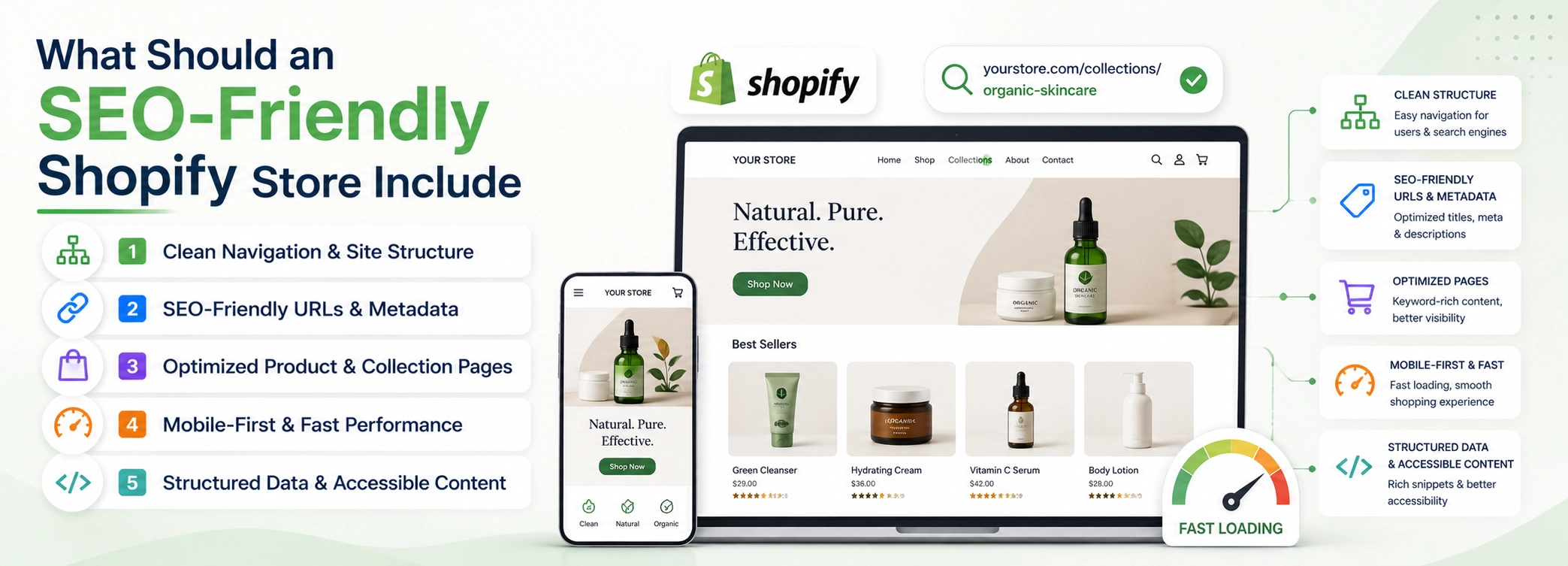
A store that’s genuinely optimized for search includes several specific technical and structural elements working together.
Core Elements of an SEO Friendly Shopify Store
- Optimized navigation, clear, shallow menu structures that don’t bury products more than two or three clicks from the homepage
- Clean URLs, short, descriptive URLs without unnecessary parameters or auto generated strings
- Breadcrumbs, helping both users and search engines understand page hierarchy
- Metadata, unique title tags and meta descriptions for every page, not defaults copied across templates
- Structured data (schema markup), helping search engines understand products, reviews, pricing, and availability, which can also enable rich results in search
- Logical page architecture, collections, subcollections, and products organized in a way that mirrors how customers actually shop
Organizing Product and Collection Pages for Users and Search Engines
Product pages should be built around a template that supports unique content, not just a repeated structure filled with the same boilerplate text. Collection pages, meanwhile, often have the biggest SEO opportunity on a Shopify store, they can target broader, higher volume search terms that individual product pages can’t compete for.
Mobile First Design, Speed, and Accessibility
Because search engines evaluate the mobile version of a site first, mobile first design isn’t just a UX consideration, it’s a ranking factor. This means:
- Images optimized and properly sized for mobile devices
- Fast loading pages even on slower mobile connections
- Accessible content, including proper alt text and readable font sizes
Examples of SEO friendly Shopify store features include filterable collection pages with clean URL parameters, FAQ sections with structured data, optimized product image alt text, and blog content that links naturally into relevant product and collection pages.
How Does Shopify Development Affect Search Rankings
Technical development decisions directly shape how well a store can be crawled, indexed, and understood by search engines, and by extension, how well it can rank.
Crawlability, Indexation, Speed, and User Experience
Development choices influence whether search engines can efficiently crawl every important page, whether those pages get indexed correctly, how fast they load, and how users experience the site once they arrive. A poorly built theme can create crawl traps, broken internal links, or duplicate URL variations that confuse search engines and dilute ranking potential.
The SEO Impact of Unnecessary Apps, Scripts, and Poorly Optimized Themes
Every app added to a Shopify store typically injects its own JavaScript and CSS. A handful of unnecessary apps can:
- Slow down page load times significantly
- Create duplicate content through overlapping functionality
- Conflict with each other, causing display or performance issues
- Add unnecessary code bloat that search engines have to crawl through
Poorly optimized themes compound this problem, especially cheap or outdated themes that weren’t built with performance or clean code in mind.
Identifying Technical Issues Before Launch
A collaborative process between developers and SEO specialists, reviewing site architecture, testing page speed, checking for crawl errors, and validating structured data, before a store goes live catches problems while they’re still cheap and easy to fix.
A Shopify Specialist who understands both the platform’s technical quirks and ongoing SEO best practices can help maintain this technical health well after launch, not just during the initial build.
What Shopify Design Practices Improve User Experience
Good user experience and good SEO overlap more than most people expect. Search engines increasingly evaluate signals tied to how users actually interact with a page.
Practices That Improve Both UX and Search Performance
- Clear navigation that helps shoppers find what they’re looking for without extra clicks
- Product filtering that lets customers narrow results by size, price, color, or other attributes
- Readable content with appropriate font sizes, spacing, and contrast
- Strong calls to action that guide shoppers toward the next step
- Simple checkout journeys that minimize friction and abandoned carts
Balancing Visual Design With SEO and Performance
A Shopify web designer has to weigh visual impact against technical performance constantly, a beautiful hero video, for example, might hurt page speed if not implemented carefully. The best designers know how to achieve a premium look without sacrificing load times or crawlability.
Mobile Friendly Layouts and Reusable Templates
Building reusable layout sections, for product pages, collection pages, and landing pages, helps maintain consistency and speed as a store scales. Shopify website designers can create flexible section based templates that keep pages fast and consistent without needing custom design work for every new page added to the store.
How Can Custom Shopify Development Services Support SEO
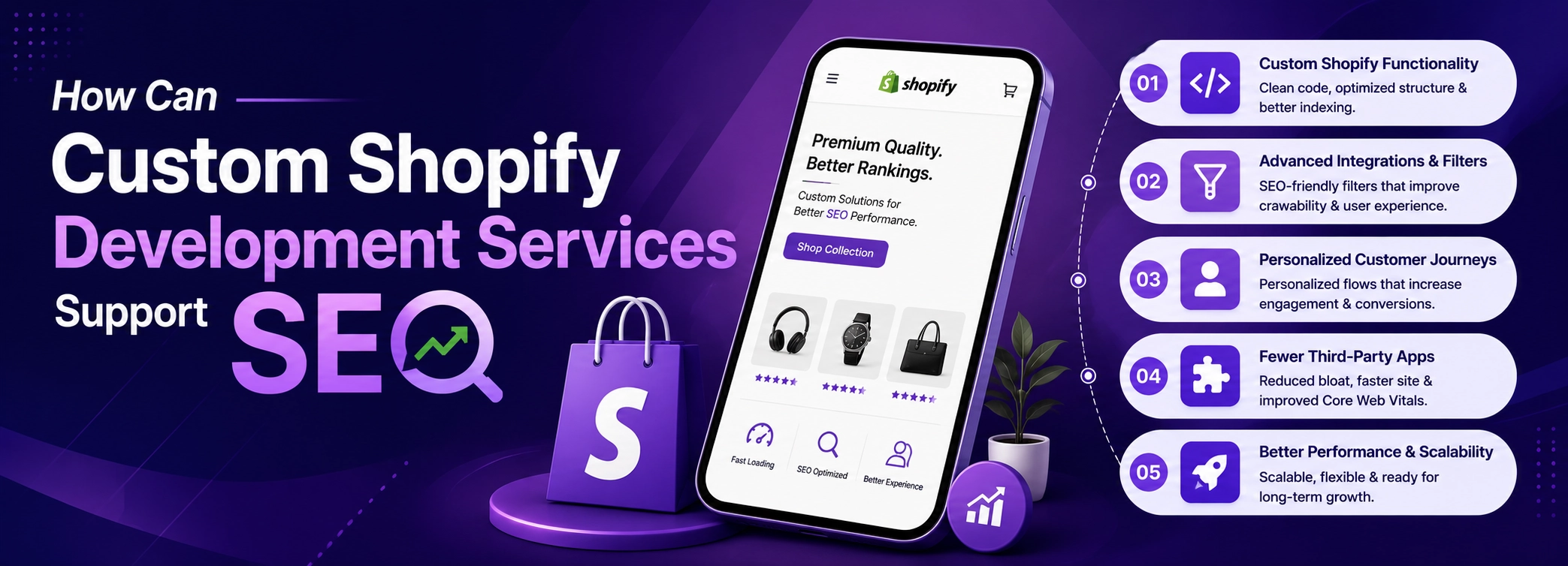
Standard themes and apps work well for many stores, but businesses with specific functionality needs or larger catalogs often benefit from custom development.
When Businesses Need Custom Shopify Development
Custom development typically becomes worthwhile when a business needs:
- Unique product configurators or filtering systems not supported by standard apps
- Specialized customer journeys, such as B2B pricing tiers or subscription flows
- Integrations with existing business systems (ERP, inventory, CRM)
- Performance improvements that off the shelf themes can’t deliver
Custom Sections, Integrations, and Reducing App Dependency
Custom Shopify development services can replace several third party apps with purpose built functionality, reducing the number of scripts loading on each page. This isn’t just cleaner from a maintenance standpoint, it directly supports better page speed and fewer conflicts between competing app scripts.
Clean, custom built code also tends to scale better as a store grows, since it’s built specifically for that store’s catalog size, traffic patterns, and business logic rather than trying to accommodate every possible use case a generic app or theme has to support.
Optimize Your Shopify Store
Not getting the results you want? Let our Shopify experts find and fix what’s holding your store back.
What Should You Check Before Choosing a Shopify Theme
Theme choice sets the technical ceiling for a store’s performance and SEO potential, so it deserves careful evaluation before launch.
Key Factors to Evaluate
| Factor | What to Check |
|---|---|
| Mobile responsiveness | Does the theme adapt cleanly across screen sizes, not just resize? |
| Page speed | Test load times with real product images and a realistic app stack, not the theme demo |
| Code quality | Is the code clean and semantic, or bloated with unnecessary scripts? |
| Customization options | Can sections be rearranged and styled without heavy custom coding? |
| SEO compatibility | Does the theme support clean URLs, structured data, and proper heading hierarchy? |
How Theme Selection Affects Future Development
The theme you choose affects how easily developers can build on top of it later. A theme with messy, not standard code can make future customization slower and more expensive, since developers have to work around existing limitations rather than building cleanly.
Testing Across Devices and Recommendations for Long Term Growth
Always test a theme on real mobile devices and desktop browsers before committing, theme preview demos often look different from how the theme performs with your actual products, images, and apps installed. Choose a theme that’s actively maintained and updated, with a track record of supporting new Shopify features, rather than one that hasn’t been updated in years.
How Should Shopify Product and Collection Pages Be Built
Product and collection pages are where most of a Shopify store’s organic traffic potential lives, so how they’re structured matters significantly.
Building Strong Product Templates
Product pages should support:
- Unique product descriptions, not copied manufacturer text
- Optimized headings that include relevant, natural keyword usage
- High quality, properly compressed images with descriptive alt text
- Customer reviews, which add fresh, relevant content over time
- FAQs addressing common customer questions
- Structured data to support rich results in search listings
Collection Pages and Commercial Search Terms
Collection pages are often better positioned to rank for broader, higher volume commercial search terms than individual product pages. A collection page for “women’s running shoes,” for example, can target a much larger search audience than any single product listing within it.
Internal Linking Between Products, Collections, and Blog Content
Linking blog content to relevant collections and products, and linking related products to each other, helps search engines understand relationships between pages and helps customers discover more of your catalog naturally.
Building Scalable Templates Without Thin Content
Shopify website developer need to build templates that work at scale without producing thin or duplicate content. This usually means designing flexible content blocks (for descriptions, specifications, reviews, and FAQs) that can be filled in uniquely for each product, rather than a rigid template that encourages copy pasted content.
Why Does Shopify Website Speed Matter for SEO and Sales
Page speed sits at the intersection of user experience, search rankings, and conversions, making it one of the highest impact areas of Shopify development.
The Relationship Between Speed, Search, and Conversions
Slow loading pages increase bounce rates and reduce the likelihood that a visitor completes a purchase. Search engines also factor loading performance, responsiveness, and visual stability into how they evaluate page quality, collectively known as Core Web Vitals, based on Google’s official performance guidance.
Practical Ways to Improve Speed
- Image compression, reducing file sizes without visibly sacrificing quality
- Lazy loading, loading images and content as users scroll, rather than all at once
- App management, regularly auditing and removing apps that add unnecessary scripts
- Lightweight themes, choosing themes built for performance rather than heavy, feature bloated ones
Why Mobile Performance Deserves Special Attention
Given how much ecommerce traffic and search indexing now centers on mobile, a store that performs well on desktop but poorly on mobile is still at a significant disadvantage. Mobile networks and devices are often slower and less powerful than desktop setups, so performance optimizations need to be tested specifically in mobile conditions.
Ongoing Testing and Monitoring
Speed isn’t a one time fix. New apps, theme updates, and added content can all affect performance over time, which is why regular testing, using tools like Google PageSpeed Insights or Lighthouse, should be part of ongoing store maintenance.
What Technical SEO Tasks Should a Shopify Developer Handle
Technical SEO is easy to overlook until something breaks, a bad migration, a missed redirect, or an accidentally deindexed page can undo months of ranking progress.
Core Technical SEO Responsibilities
- Redirects, ensuring old URLs point to the correct new pages after any restructuring
- Canonical tags, preventing duplicate content issues, especially across filtered or sorted collection URLs
- XML sitemaps, keeping sitemaps accurate and submitted to search engines
- Indexation control, making sure important pages are indexable and unnecessary pages (like internal search results) are not
- Structured data, implemented correctly and validated regularly
- Broken links and 404 pages, identified and fixed before they accumulate
Before Launch Technical SEO Checks
Before a new store or a redesign goes live, a thorough technical review should confirm redirects are mapped, metadata is in place, structured data validates correctly, and there are no crawl errors.
Migration Related SEO Risks
Store migrations, whether moving to Shopify from another platform or redesigning an existing Shopify store, carry real risk of traffic loss if URLs change without proper redirects, or if content gets lost in the process. A Shopify developer partner who understands these risks can plan migrations carefully to protect existing rankings rather than starting from zero.
How Do Shopify Apps Affect Store Performance and SEO
Apps extend Shopify’s functionality significantly, but each one comes with a performance cost that needs to be weighed against the value it provides.
The Trade Off Between Functionality and Performance
Apps can add genuinely useful features, reviews, upsells, subscriptions, advanced filtering, but they often do so by injecting additional scripts into every page load, whether or not that functionality is being used on that specific page.
Common Problems: Conflicts, Duplication, and Script Bloat
- Multiple apps performing overlapping functions (two review apps, two popup tools)
- JavaScript conflicts that cause layout or functionality issues
- Cumulative script weight that slows down every page on the store
When Custom Development Makes More Sense Than Another App
If a store is relying on several apps to achieve one piece of functionality, or if an app’s script weight is disproportionate to the value it provides, custom development can often deliver the same result more efficiently and with less ongoing overhead.
Regularly Auditing and Removing Unused Apps
A simple but often skipped practice: periodically reviewing installed apps and removing anything no longer actively used. Even inactive or barely used apps can continue loading scripts that slow down the store.
When Should You Hire a Shopify Developer for Your Store
Not every Shopify project requires professional development help, but several situations clearly benefit from it.
Situations That Call for Professional Development Support
You should consider hiring Shopify developer for:
- New store builds, especially with custom design or functionality requirements
- Store redesigns or rebrands
- Platform migrations from another ecommerce system
- Custom features not available through standard apps
- Third party integrations (ERP, CRM, fulfillment systems)
When DIY Development May Be Sufficient
Simple stores with a small catalog, standard theme, and minimal customization needs can often be managed without dedicated development support, especially in the early stages of a business.
The Benefits of Professional Testing and Troubleshooting
Professional developers bring structured testing processes, catching issues across browsers, devices, and edge cases that are easy to miss without dedicated QA. They can also troubleshoot performance and functionality issues faster, since they understand Shopify’s platform architecture in depth.
What to Evaluate Before Hiring a Developer
Before hiring, businesses should evaluate a developer’s Shopify specific experience, portfolio of similar projects, understanding of SEO fundamentals, and their process for testing and after launch support.
What Should You Look for in a Shopify Developer Partner
Choosing the right development partner has a lasting impact on a store’s technical health and growth potential.
Key Criteria to Evaluate
- Shopify experience, specific platform expertise, not just general web development
- Technical expertise, clean coding practices and familiarity with Shopify’s theme architecture
- SEO knowledge, understanding of how development decisions affect search visibility
- Portfolio, demonstrated experience with stores similar in size or industry
- Communication, clear, responsive collaboration throughout the project
- Testing and support, a defined process for QA and after launch maintenance
Why Business and Technical Understanding Both Matter
A Shopify developer partner needs to understand not just how to build a feature, but why it matters to the business, what it’s meant to achieve for conversions, customer experience, or operational efficiency.
Evaluating Previous Projects and Client Results
Ask for examples of past work along with measurable outcomes where possible, improvements in page speed, organic traffic growth, or conversion rate changes tied to development work.
The Value of Ongoing Support After Launch
A store’s needs don’t stop at launch. Ongoing support for updates, troubleshooting, and iterative improvements is often what separates a store that keeps improving from one that slowly accumulates technical debt.
How Can a Shopify Agency New York Help Build an SEO Friendly Store
Businesses searching for a Shopify agency New York are typically looking for a local or regionally accessible partner who can combine design, development, SEO, integrations, and support into one cohesive project.
What to expect from a capable agency in this category:
- A discovery process that identifies both business goals and technical requirements
- Design and development that’s planned around SEO from the start
- Integration support for payment systems, marketing tools, and operations software
- After launch support for ongoing improvements
Local businesses evaluating a New York based agency should look at proven Shopify work, not just general web design experience. An agency that understands both technical development and organic search will build a store that’s positioned to grow, not just launch. Reviewing case studies, portfolios, and client feedback, and asking about their development process specifically, gives a clearer picture than marketing claims alone.
What Can a Los Angeles Shopify Agency Offer Growing Ecommerce Brands
A Los Angeles Shopify agency working with growing DTC and ecommerce brands typically needs to support more than just store design, including custom development, SEO, third party integrations, and conversion rate improvements.
Growing brands have specific needs:
- Scalable product catalogs that can expand without technical rework
- Marketing integrations (email platforms, loyalty programs, ad pixels)
- Conversion optimization as traffic increases
- SEO that supports sustainable, long term organic growth alongside paid channels
The right agency focuses on scalability rather than just creating an attractive storefront. Before selecting an agency, growing brands should ask how the agency approaches technical SEO, how they’ve supported similar stage businesses through growth, and what their process looks like for ongoing optimization after launch.
Why Do Businesses Choose Shopify Experts Houston for Development Support
Businesses searching for Shopify experts Houston are often looking for support across redesigns, custom functionality, integrations, SEO, performance, and ongoing maintenance.
Common services sought include:
- Store redesigns to modernize outdated storefronts
- Custom functionality for specific business models
- Third party integrations with existing systems
- SEO improvements to boost organic visibility
- Performance optimization and ongoing technical maintenance
Rather than focusing on location alone, businesses should evaluate Shopify experts based on their actual technical expertise, portfolio quality, clarity of communication, and the level of after launch support they offer, location is convenient, but capability is what determines results.
How Can a Shopify Website Design Company Chicago Improve Store Performance
A Shopify website design company Chicago should combine visual design with UX, mobile responsiveness, and performance, not treat them as separate priorities.
Effective design companies:
- Design product and collection pages around actual customer intent, not just aesthetics
- Let SEO influence navigation, page structure, and technical implementation from the start
- Build mobile first, with performance tested on real devices
- Balance creative quality with measurable outcomes
When evaluating a design company, look beyond portfolio visuals, ask about measurable results they’ve delivered for other ecommerce clients, such as improvements in page speed, conversion rate, or organic traffic.
How Do You Choose Between a Shopify Specialist, Consultant, and Agency
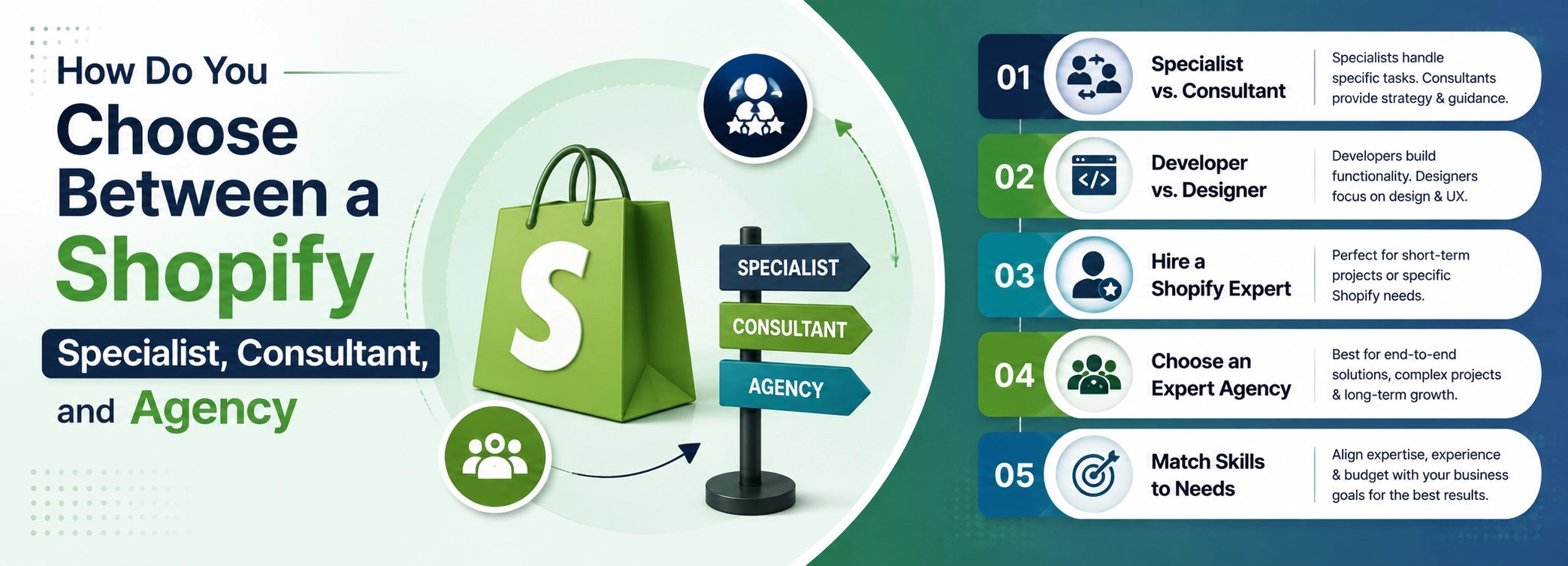
Understanding the differences between these roles helps businesses match the right type of support to their actual needs.
| Role | Best Suited For |
|---|---|
| Shopify Specialist | Focused technical tasks, theme customization, performance fixes, specific integrations |
| Shopify Consultant | Strategic guidance, audits, roadmaps, and recommendations without hands on development |
| Shopify Developer | Hands on coding, building features, custom sections, and technical implementation |
| Shopify Designer | Visual design and UX, layouts, branding, and customer facing presentation |
| Shopify Agency | Full-service support, combining design, development, SEO, and ongoing maintenance |
When to Hire Shopify Expert Support for Specific Needs
If you need help with one specific problem, a performance issue, a single integration, a technical SEO audit, a specialist or consultant may be the more efficient choice.
When a Full Service Agency Makes More Sense
For new store builds, major redesigns, or ongoing growth support across multiple areas (design, development, SEO, and maintenance), a full service Shopify expert agency typically delivers better coordination and consistency than managing multiple freelancers separately.
What Is the Difference Between Standard and Custom Shopify Development
Choosing between standard and custom development depends on a business’s specific functionality needs, budget, and growth plans.
Comparison Table: Standard vs. Custom Shopify Development
| Factor | Standard Shopify Development | Custom Shopify Development |
|---|---|---|
| Development time | Faster | Longer |
| Customization | Moderate | High |
| Cost | Generally lower | Generally higher |
| Unique features | Limited | Extensive |
| Maintenance | Simpler | More technical |
| Scalability | Good | Strong for specialized needs |
When Standard Features Are Enough
Standard Shopify development works well for businesses with straightforward catalogs and typical ecommerce needs, where existing themes and apps can deliver the required functionality without significant modification.
When Custom Development Provides Stronger Value
Custom development becomes worthwhile when a business has unique operational requirements, needs deeper integrations, or has outgrown what standard themes and apps can support efficiently.
When Should You Hire a Dedicated Shopify Developer
For stores with ongoing, frequent development needs, a dedicated Shopify developer arrangement can be more efficient than project based hiring.
When Dedicated Development Makes Sense
- Frequent feature updates or seasonal store changes
- Ongoing custom development needs
- Regular integrations with new tools or platforms
- Continuous technical maintenance requirements
- Active store expansion (new product lines, markets, or sales channels)
Dedicated Versus Project Based Development
Project based development works well for one time builds or redesigns. Dedicated development, by contrast, suits businesses that need continuous support and benefit from a developer’s deepening familiarity with the store’s specific architecture, history, and technical decisions over time, reducing onboarding time for each new task.
What Shopify Consulting Services Can Improve an Existing Store
For stores that are already live but underperforming, Shopify consulting services can identify specific issues and create a practical path forward.
What Shopify Consulting Typically Covers
- Store audits covering technical, SEO, UX, and conversion factors
- Redesign recommendations based on audit findings
- App reviews to identify performance or functionality issues
- Performance improvement recommendations
- Growth planning aligned with business goals
Creating a Practical Improvement Roadmap
A good Shopify Consultant doesn’t just list problems, they prioritize them based on impact and effort, giving businesses a clear roadmap for what to fix first.
Supporting Decision Making Before Major Investment
Consulting is particularly valuable before committing to a major redesign or development project, helping businesses make informed decisions about scope and priorities before investing significant budget.
How Can a Shopify Development Company Support Long Term Growth
Development needs evolve as a business grows, which is why choosing the right long term partner matters.
Supporting Growth Over Time
A capable Shopify development company supports:
- New feature development as business needs change
- Integrations with new tools and platforms
- Redesigns as branding or customer expectations evolve
- Ongoing SEO improvements as competition and search behavior shift
- Technical maintenance to keep the store secure and performant
How Requirements Change as Catalogs and Customer Bases Grow
A store that starts with a few dozen products and a single market may eventually need multi currency support, more sophisticated filtering, or integrations with fulfillment partners as it scales, requirements a growing business often can’t predict at launch.
Choosing Partners for Both Immediate and Long Term Needs
Businesses should choose development partners capable of supporting both the immediate build and future growth, rather than needing to switch partners every time requirements change.
Comparison Table: DIY Shopify Development vs. Professional Shopify Services
| Factor | DIY Development | Professional Shopify Services |
|---|---|---|
| Technical expertise | Limited | Experienced |
| Custom functionality | Restricted | Highly flexible |
| SEO implementation | Basic | Strategically planned |
| Troubleshooting | Self managed | Professional support |
| Scalability | Depends on setup | Planned for growth |
| Ongoing maintenance | Manual | Dedicated support available |
How Can You Measure the Success of Shopify Development
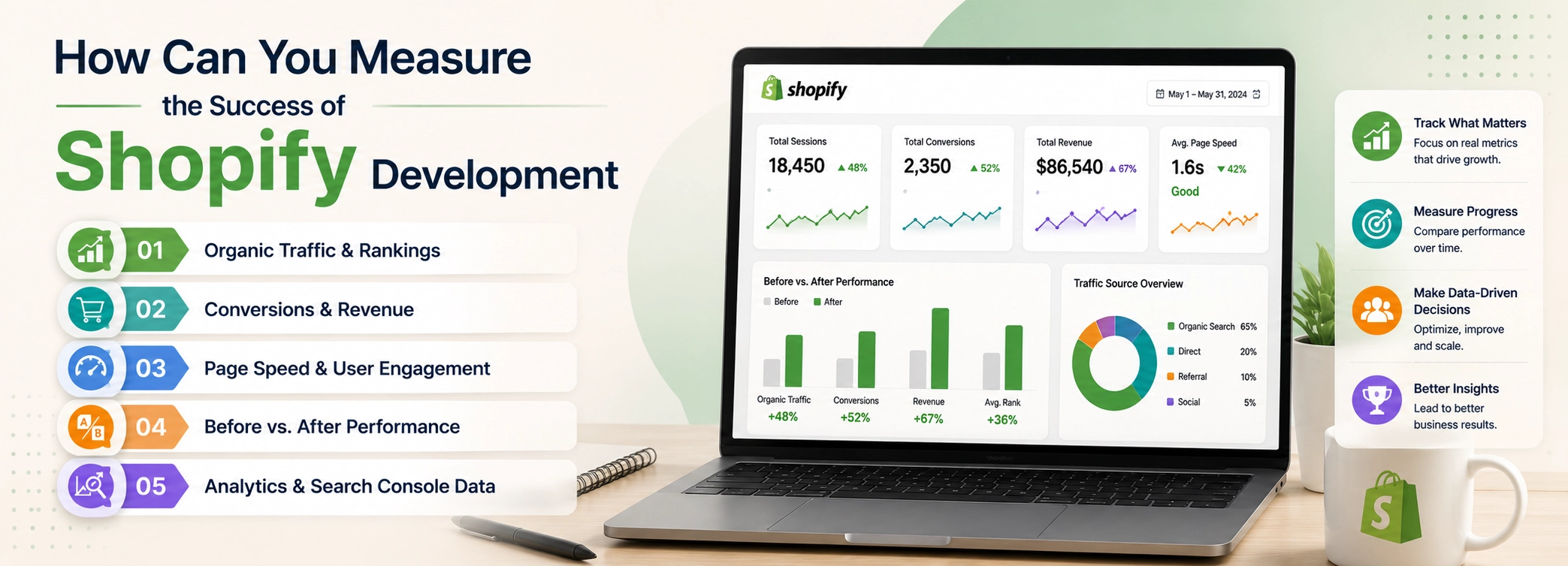
Development work should ultimately be judged by business outcomes, not just how the store looks.
Key Metrics to Track
- Organic traffic, growth in visitors coming from search engines
- Rankings, position improvements for target keywords
- Conversions, how well traffic translates into sales
- Revenue, overall business impact
- Page speed, ongoing performance benchmarks
- User engagement, time on site, pages per session, bounce rate
Measuring Outcomes, Not Just Appearance
A redesign that looks more modern but doesn’t improve any of these metrics hasn’t necessarily delivered value. Development success should be tied to measurable business outcomes.
Comparing Performance Before and After Changes
Establishing baseline metrics before any development project, and comparing them afterward, is the clearest way to understand whether changes actually worked.
Recommended Tools
Google Analytics, Google Search Console, and Shopify’s own ecommerce reporting together provide a fairly complete picture of how development and SEO changes are performing over time.
Industry Context: Why This Matters More Than Ever
A few well established points from authoritative sources reinforce why SEO friendly development deserves priority:
- Google’s Core Web Vitals initiative measures loading performance, interactivity, and visual stability as part of how the search engine evaluates page experience, reinforcing why speed and stability need to be considered during development rather than fixed later.
- Mobile commerce continues to represent a majority share of global ecommerce traffic, making mobile first development a baseline requirement rather than an optional enhancement.
- Checkout usability research from organizations like the Baymard Institute consistently finds that a meaningful share of online shopping carts are abandoned due to friction in the checkout process, underscoring why simple, well designed checkout journeys matter as much for conversions as they do for user experience.
- Organic search remains one of the most cost effective, sustainable traffic sources for ecommerce businesses, especially compared to the rising cost of paid acquisition.
(Businesses should verify the latest statistics directly from Google’s official Core Web Vitals documentation, Shopify’s official reports, and current Statista or Baymard Institute research before publishing, since these figures are regularly updated.)
Conclusion
Shopify development services work best when SEO isn’t treated as an afterthought. A store built with SEO friendly architecture, thoughtful UX, strong performance, mobile first design, and room to scale gives a business a real foundation for organic growth, not just a store that looks good on launch day.
Choosing the right development partner matters. The right team prevents avoidable technical problems, builds a store that search engines can crawl and understand, and creates a foundation that supports growth for years, not just months.
WillShall Consulting brings together Shopify development and SEO under one roof, with experience building stores that are designed to perform, technically sound, search optimized, and built to scale alongside your business. Whether you’re launching a new store, planning a redesign, or want an honest audit of what’s holding your current site back, WillShall Consulting can help you build (or rebuild) a Shopify store that’s genuinely ready for both customers and search engines.
Ready to Grow Your Shopify Store?
Build a fast, SEO-friendly Shopify store that is ready to scale with your business.
I bring a wealth of knowledge and experience to WillShall Consulting with two decades of expertise in Website Design, Development, and Digital Marketing, My journey has been marked by a passion for creating innovative web solutions that not only meet but exceed client expectations. As an avid analyst, I dedicate myself to understanding each customer’s unique needs, ensuring that our web solutions are not just functional but exceptional.
Common Questions About Shopify Development Services

Looking to boost your online presence and reach more customers in your local area?
Explore Local SEO ServiceKnow your website’s SEO Score.
Get a customize SEO Audit report & improve your website statistics.