

 Upwork
 Fiverr
 People Per
Hour
People Per
Hour
The End of Cookie-Cutter Shopify Web Design Agency Services
 By Manoj Kandwal
|
03-Jul-2026
By Manoj Kandwal
|
03-Jul-2026
Generic themes. Recycled layouts. Product pages that look like they were built from the same mold, no matter the brand behind them. Online shoppers notice this pattern even when they cannot name it, and it quietly costs stores sales every single day. The cookie-cutter era of Shopify design is ending, and brands that want to stand out now need more than a theme picker and a checkout button. This article breaks down what makes a Shopify web design agency worth hiring, what expert-led builds actually look like, and how to choose a partner who treats your store like a business, not a template.
Talk to our Shopify design team today.
Stop settling for a store that looks like everyone else’s
Why Every “Custom” Shopify Store Looks the Same Anyway
Most agencies reuse the same handful of theme frameworks and simply swap out colors and logos. They call it custom, but the bones underneath stay identical from client to client. Navigation patterns repeat. Homepage sections repeat. Even the “unique” animations show up on ten other stores in the same niche.
Real customization starts with strategy, not a theme selector. A store built around actual customer behavior and product logic looks and functions differently from one built to hit a launch deadline. That difference shows up in bounce rates before it ever shows up in reviews.
The Real Cost of Hiring a Template Factory Instead of a Shopify Expert Agency
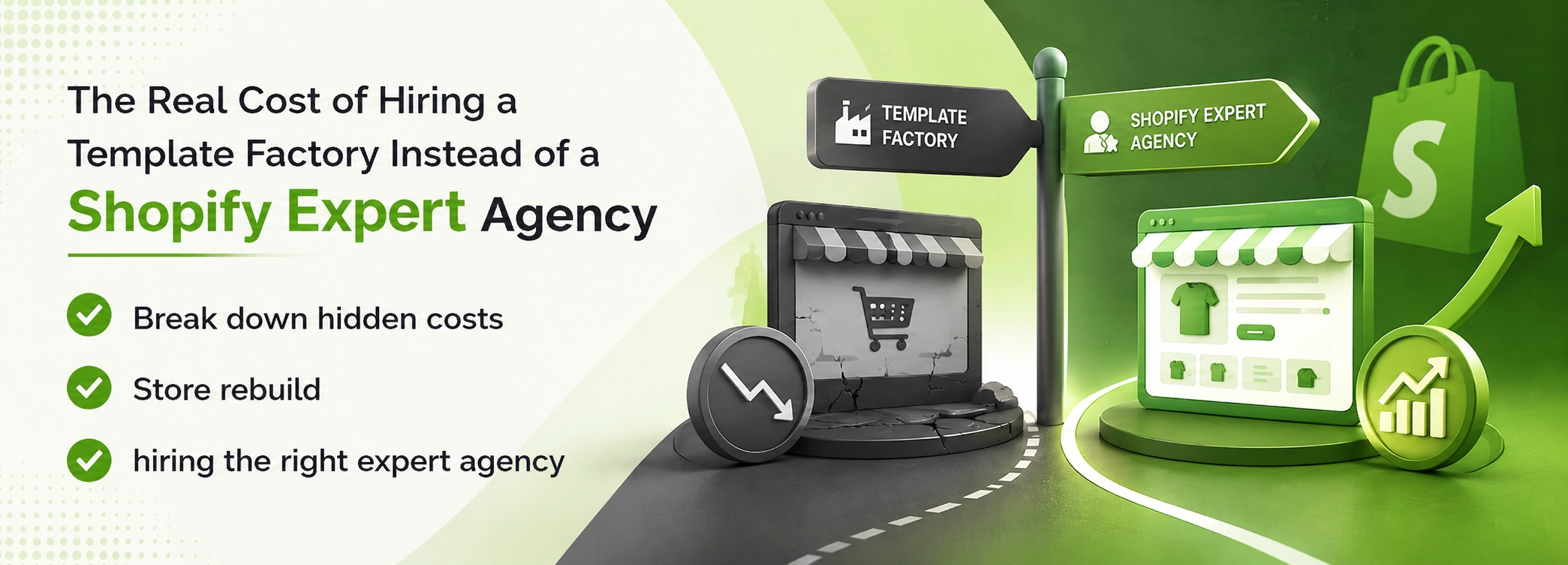
Cheap builds carry hidden costs that surface months later. Rework, lost conversions, and a brand that blends into its competitors all trace back to the same root cause: a store designed for speed of delivery rather than long-term performance. Many template-based builds need a full rebuild within a year or two, which means paying twice for something that should have worked the first time.
A Shopify expert agency costs more upfront, but the math changes once you factor in the rebuild, the lost traffic, and the months spent fixing what should have been right from day one. Paying for expertise early is almost always the cheaper path.
What Separates a Shopify Plus Expert From a Regular Developer
Enterprise-level stores need more than basic theme knowledge. Checkout customization, app architecture, and scalability planning all require a technical depth that most general developers simply do not have. A Shopify Plus expert understands how to build systems that hold up under high traffic and complex catalog structures. WillShall Consulting brings this kind of Shopify Plus experience to enterprise builds, handling the checkout and infrastructure decisions that generalist developers tend to overlook.
“Most developers can install an app. Far fewer can architect a checkout flow that scales past ten thousand orders a month without breaking,” said Marcus Reyes, a Shopify Plus strategist at Northbridge Digital Partners in Austin. That gap between installing and architecting defines the line between a general developer and a true Shopify Plus specialist.
Signs Your Current Site Was Built on Autopilot
Some warning signs are easy to spot once you know what to look for. Slow load times, generic copy, missing mobile optimization, and a graveyard of unused apps all point to a store built on autopilot rather than intention.
- Pages that take more than three seconds to load on mobile
- Product descriptions that read like every other store in the niche
- A checkout flow that looks nothing like the rest of the brand
- Apps installed and forgotten, quietly slowing the site down
These signs hurt trust and sales long before a customer ever files a complaint. A quick self-audit using this list often reveals more problems than owners expect.
The Shopify Design Experts Difference: Strategy Before Pixels
Good design work starts long before anyone opens a design tool. Brand research, competitor analysis, and customer journey mapping all shape decisions that come later. Shopify design experts treat this discovery phase as the foundation, not a formality to rush through.
Every design decision should trace back to a business goal, not a passing trend. That is the real difference between a one-call, one-template approach and a process built around what actually moves the needle for a specific brand.
Why Cookie-Cutter Stores Quietly Kill Conversion Rates
Templated stores share the same friction points again and again: cluttered navigation, weak calls to action, and product pages that give shoppers no reason to trust the brand. None of these issues look dramatic on their own, but together they chip away at conversion rate week after week.
Consider a store that simplifies its navigation and rewrites its product pages around real customer questions. Conversion rates often jump within weeks, not months, because design and conversion are never separate problems. They are the same problem wearing different names.
What to Expect When You Hire a Shopify Expert Who Actually Listens
The onboarding process should feel different from the start. A proper discovery call digs into goals, audience, and pain points rather than jumping straight into a sales pitch. When you hire a Shopify expert who actually listens, the process includes a dedicated point of contact and timelines that hold up.
Communication should stay transparent from kickoff to launch. Vague updates and disappearing project managers are common complaints about budget agencies, and a genuine expert avoids both by keeping clients informed at every stage.
The SEO Blind Spot Most Web Design Agencies Ignore
Search visibility often gets treated as an afterthought, something bolted on after the design work wraps up. That approach leaves technical SEO issues baked directly into the site structure before the store even launches.
Common problems include duplicate content across collection pages, missing alt text, and slow load speeds caused by unoptimized images. Fixing these after launch takes far more work than building around them from the start.
How a Shopify SEO Expert Builds Visibility Into the Store, Not Bolted On After
Search visibility should shape the site architecture from day one, not arrive as an afterthought. A Shopify SEO expert maps keywords into category and product structuring before a single page goes live, which sets up organic growth instead of chasing it later.
Retrofitting SEO onto an existing store almost always costs more and delivers slower results than building it in from the start. Brands that treat search visibility as core infrastructure tend to outrank competitors who treat it as a bolt-on feature.
Custom Development vs Theme Editing: What You’re Really Paying For
| What’s Involved | Theme Editing | Custom Development |
|---|---|---|
| Code ownership | Shared, limited control | Full ownership |
| Performance impact | Bloated, slower load | Optimized for speed |
| Feature flexibility | Restricted by theme | Built around your needs |
| Long-term cost | Rises with rebuilds | Stable and predictable |
| Brand differentiation | Minimal | Strong |
Theme editing and custom development sit worlds apart in scope and ownership. Theme editing adjusts what already exists within someone else’s framework. Custom development builds something that belongs entirely to the brand, with no ceiling on what it can eventually do.
Theme editing genuinely works fine for small stores with simple needs. It becomes a shortcut, though, once a brand grows past basic functionality and starts hitting walls the theme was never built to handle. Paying for real development work at that stage protects the investment already made.
Why Shopify Ecommerce Development Services Need to Be Built Around Your Products, Not a Template
Product logic should drive design decisions, not the other way around. Variant handling, bundling, and inventory logic all differ wildly between industries, and a template rarely accounts for that complexity. Strong Shopify e-commerce development services start with the product catalog and build outward from there.
A furniture brand with made-to-order pieces needs different tools than a supplement company managing subscriptions. Templated builds tend to fail exactly where product needs get specific, which is where real development work earns its cost.
Shopify Experts Houston Businesses Trust Over Generic Shopify Builds
Ecommerce brands across Houston increasingly choose custom builds over generic ones, and the shift makes sense given the market. Logistics complexity, multi-location inventory, and local search competition all demand more than a one-size-fits-all theme. Shopify experts Houston companies tend to understand these regional pressures firsthand.
A Houston-based supplement brand managing three warehouses needs a store that reflects that complexity in real time. Custom builds handle this kind of nuance in ways templated stores simply cannot.
What Happens After Launch: The Support Gap Cookie-Cutter Agencies Leave Behind
Budget agencies tend to disappear the moment a site goes live. Emails go unanswered, bugs pile up, and performance quietly degrades over months with no one watching.
Ongoing support should include regular updates, prompt bug fixes, and routine performance checks. A long-term partnership model catches small issues before they turn into lost revenue, which is exactly what a one-time vendor relationship fails to do.
How Shopify SEO Services Should Actually Work From Day One
Technical SEO, content SEO, and local SEO should work together as one system rather than three separate add-on packages. Strong Shopify SEO services integrate directly into the store structure instead of sitting bolted on the side.
Measurable outcomes matter here. Ranking improvements, organic traffic growth, and faster indexation all signal that SEO was built in properly rather than patched on after the fact.
| SEO Element | Add-On Package | Built In From Day One |
|---|---|---|
| Site architecture | Retrofitted | Planned from launch |
| Page speed | Often overlooked | Optimized early |
| Keyword mapping | Generic | Product specific |
| Technical SEO | Reactive fixes | Proactive structure |
| Ongoing optimization | Rare | Continuous |
The Warning Signs of a One Size Fits All Shopify Agency
Certain red flags show up early, often during the very first sales call. Fixed packages with no room for customization, a missing discovery process, and a portfolio where every project looks the same all predict a templated outcome before the contract even gets signed. Shopify SEO experts often point to these same warning signs when advising clients on what to avoid.
Asking pointed questions before signing anything protects against months of wasted budget. A confident agency answers specifics directly instead of retreating into vague marketing language.
Migrating Without the Migraine: What a Real Shopify Expert Agency Handles Differently
Migration carries real risk: lost SEO equity, broken redirects, and data that disappears during the transfer. These problems compound quickly once a store goes live with gaps in its migration checklist.
- A full audit of existing URLs and redirect mapping
- Backup of all product, customer, and order data
- Testing on a staging environment before the switch
- Post-launch monitoring for broken links or indexing drops
Careful, expert-led migration protects everything a brand already built before the switch to a new platform or design.
Why Scalability Matters More Than a Pretty Homepage
A beautiful homepage means little if the store collapses under a traffic spike or a new product launch. Templated stores often break exactly when growth arrives, which is the worst possible moment for downtime.
App choices and infrastructure decisions made early determine whether a store can handle that growth later. Shopify Plus capabilities exist specifically to support brands that expect to scale past what a basic plan can handle.
The Questions to Ask Before You Hire Any Shopify Design Team
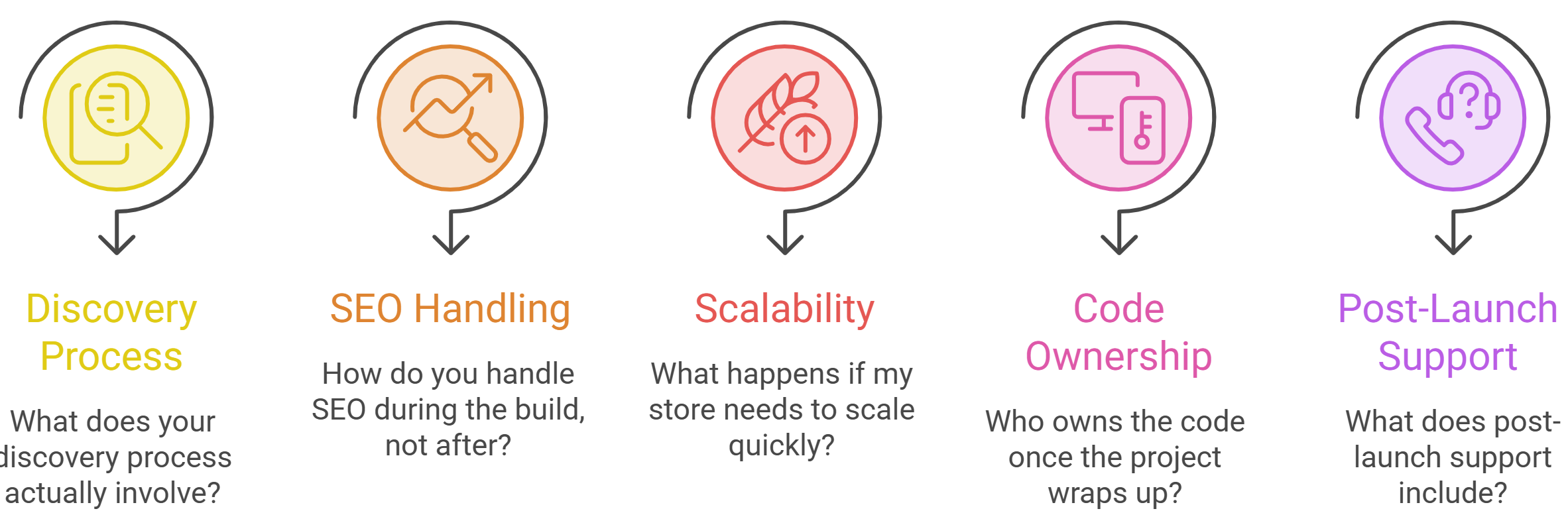
A few direct questions separate a strong agency from a weak one before any contract gets signed.
- What does your discovery process actually involve?
- How do you handle SEO during the build, not after?
- What happens if my store needs to scale quickly?
- Who owns the code once the project wraps up?
- What does post-launch support include?
Vague answers to these questions usually predict a vague outcome. Specific, confident answers point toward a team that has handled real complexity before.
What Makes a Store Actually Convert: Beyond the Template Mentality
Conversion comes down to a handful of factors covered throughout this article: user experience, page speed, search visibility, and product-first design. None of these work in isolation, and none of them happen by accident.
Stores that convert well got there through intentional decisions, not default settings left untouched. That distinction matters more than any single design trend.
Choosing a Long-Term Shopify Partner Instead of a one-time vendor
Project-based vendors disappear after launch. Long-term partners stick around for strategy check-ins, iterative improvements, and support that adapts as the business grows.
A long-term partnership typically includes quarterly performance reviews, ongoing app management, and a direct line to the same team that built the store in the first place. That continuity matters more than most owners realize until they experience the alternative.
Conclusion
Generic, templated Shopify stores have become a business liability rather than a simple design preference, and brands that keep ignoring this shift will keep losing ground to competitors who already made the move toward expert-led, SEO-integrated, custom-built commerce. WillShall Consulting has spent years helping brands make exactly that transition, building stores around strategy instead of shortcuts and treating Shopify web design agency work as a long-term investment rather than a one-time project. Brands ready to move past cookie-cutter builds already have a clear next step in front of them.
I bring a wealth of knowledge and experience to WillShall Consulting with two decades of expertise in Website Design, Development, and Digital Marketing, My journey has been marked by a passion for creating innovative web solutions that not only meet but exceed client expectations. As an avid analyst, I dedicate myself to understanding each customer’s unique needs, ensuring that our web solutions are not just functional but exceptional.
Frequently Asked Questions About Shopify Web Design Agency

Looking to boost your online presence and reach more customers in your local area?
Explore Local SEO ServiceKnow your website’s SEO Score.
Get a customize SEO Audit report & improve your website statistics.