


 Upwork
 Fiverr
 People Per
Hour
People Per
Hour
How a Los Angeles Shopify Agency Uses AI to Grow Online Stores
 By Sachin Sharma
|
22-Jul-2026
By Sachin Sharma
|
22-Jul-2026
AI is no longer a buzzword in e-commerce. It shapes how stores get built, how products get discovered, and how brands compete for attention. Many Shopify store owners still use AI in scattered ways, testing a chatbot here or a product description tool there, while a skilled Los Angeles Shopify agency builds AI into a full growth strategy from day one. This article breaks down how that actually happens in practice.
Want to see where your store stands?
Request a free Shopify AI readiness audit and get a clear picture of what AI can do for your business.
How AI Is Changing the Way Online Stores Get Built and Marketed
Store owners used to guess which product photos would convert best or which subject line would get opened. Now AI tools analyze thousands of data points in minutes and hand back answers that used to take weeks of testing. Design teams use AI to generate layout variations fast, content teams use it to draft product copy at scale, and marketing teams use it to spot patterns in customer behavior that a human might miss entirely.
This shift touches every part of store operations. Automated data analysis helps teams make faster decisions instead of waiting on monthly reports. AI-driven personalization adjusts what a shopper sees based on their browsing history, which pushes conversion rates higher without extra manual work. Stores that adopt these tools early build a real edge over competitors still running everything by hand.
5 Signs Your Shopify Store Isn’t Using AI to Its Advantage
Plenty of stores run on outdated habits without realizing it. Here are five signs that a store still has room to grow:
- No personalized product recommendations show up for returning visitors
- Reporting takes hours of manual spreadsheet work every week
- There is no strategy for showing up in AI-powered search results
- Email and marketing content sounds generic and repeats the same templates
- The store reacts slowly to shopping trends instead of anticipating them
Each of these gaps costs money quietly. A shopper who sees generic recommendations buys less than one who sees products matched to their actual interests. A team stuck on manual reporting spends less time on strategy. Fixing even two or three of these issues can shift a store’s entire trajectory within a few months.
Why Los Angeles’s Competitive E-commerce Market Rewards Early AI Adoption
Los Angeles moves fast. Trends that dominate social feeds one month fade the next, and brands based in the city feel that pressure directly. Shoppers here also expect more. They compare prices across five tabs, read reviews before clicking buy, and abandon carts the moment a site feels slow or impersonal.
A store that tests and iterates quickly wins more of these shoppers than one that sticks to a single strategy for months. AI tools give teams the speed to run that kind of testing without burning through budget. Brands that treat AI as a core part of their operations, not an afterthought, tend to catch trend spikes early and adjust inventory and marketing before competitors even notice the shift.
How Hire Shopify Expert Teams Use AI During the Development Process
Development work benefits from AI in ways that go beyond writing code faster. Teams that hire Shopify expert developers now use AI-assisted testing tools to catch bugs before they reach a live store, which cuts down on costly post-launch fixes. Automated performance monitoring flags slow-loading pages or broken checkout flows during the build itself instead of after launch.
Prototyping also moves faster. A developer can generate several design variations for a homepage or product page in the time it used to take to build one. This does not replace skilled judgment. It gives developers more room to test ideas and land on a stronger final product before a client ever sees a delay.
What Hire Shopify Developer Services Look Like With AI in the Workflow
When a business decides to hire Shopify developer support, AI now handles a lot of the repetitive groundwork. Tasks like formatting product data, checking for broken links, or generating basic code snippets happen faster with AI tools doing the first pass. Developers then review and refine that work instead of starting from scratch every time.
Human oversight still drives the outcome. AI can speed up a task, but it cannot judge whether a custom feature fits a brand’s goals or whether a checkout flow feels right for a specific audience. The strongest development teams treat AI as a tool that clears busywork off their plate so they can spend more time on strategic decisions and custom functionality that actually moves a store forward.
How Shopify Plus Experts Use AI for High-Volume Store Management
Large catalogs create problems that small stores rarely face. A brand running thousands of SKUs cannot manually track inventory trends or customer segments across every product line. Shopify Plus experts lean on AI for demand forecasting, which flags which products are about to sell out or sit unsold weeks before they become a visible problem.
Customer segmentation also scales through AI in ways manual work cannot match. Instead of grouping customers into a handful of broad categories, AI tools build detailed segments based on real purchase behavior, letting marketing teams send offers that actually match what a shopper wants. Real-time performance monitoring across a large catalog means issues get caught the day they happen, not the week after.
What a Shopify Expert Developer Automates vs What They Still Do by Hand
Knowing where to draw the line between automation and human work separates a strong Shopify expert developer from a mediocre one. Testing, routine reporting, and repetitive optimization tasks run well through automated tools. These are the areas where speed matters more than nuanced judgment, and AI handles them reliably.
Strategy, creative direction, and troubleshooting stay in human hands. A store facing a sudden traffic drop needs a person who can diagnose the real cause, not just a tool flagging a number that looks off. Full automation without oversight tends to create more problems than it solves, because AI cannot always tell the difference between a genuine issue and a normal fluctuation.
Comparison Table: Manual Shopify Management vs AI-Assisted Shopify Management
| Factor | Manual Management | AI-Assisted Management |
|---|---|---|
| Speed | Slow, relies on individual bandwidth | Fast, processes large data sets quickly |
| Accuracy | Prone to human error over time | Consistent once properly configured |
| Personalization | Limited to broad customer groups | Detailed, based on individual behavior |
| Scalability | Difficult beyond a certain catalog size | Handles large catalogs with ease |
| Cost Efficiency | Higher long-term labor cost | Lower ongoing cost after setup |
How AI Personalization Increases Conversions on Shopify Stores
Personalization used to mean showing the same “recommended for you” section to every visitor. AI changes that by tracking actual browsing behavior and adjusting recommendations in real time. A shopper browsing running shoes sees different suggestions than one browsing dress shoes, and that small shift adds up to meaningfully higher conversion rates.
Email and retargeting content benefits the same way. Instead of a single blast to every subscriber, AI tools tailor subject lines and product picks based on past purchases. Upsell and cross-sell suggestions become sharper too, since the system learns which combinations of products customers tend to buy together instead of guessing based on general assumptions.
How a Shopify Partner Uses AI to Predict and Respond to Shopping Trends
A reliable Shopify partner does not wait for a trend to peak before reacting. AI tools analyze search volume and sales data continuously, which surfaces emerging demand while there is still time to act on it. This kind of early signal lets a team adjust inventory and marketing budget ahead of a spike instead of scrambling once it hits.
This approach cuts down on guesswork during seasonal planning. Instead of relying purely on last year’s numbers, teams factor in current search behavior and social trends to build a more accurate forecast. A Los Angeles Shopify agency operating
in a fast-moving market depends heavily on this kind of forward-looking data to keep clients ahead of shifting demand.
6 Ways AI Is Being Used to Grow Shopify Stores in 2026
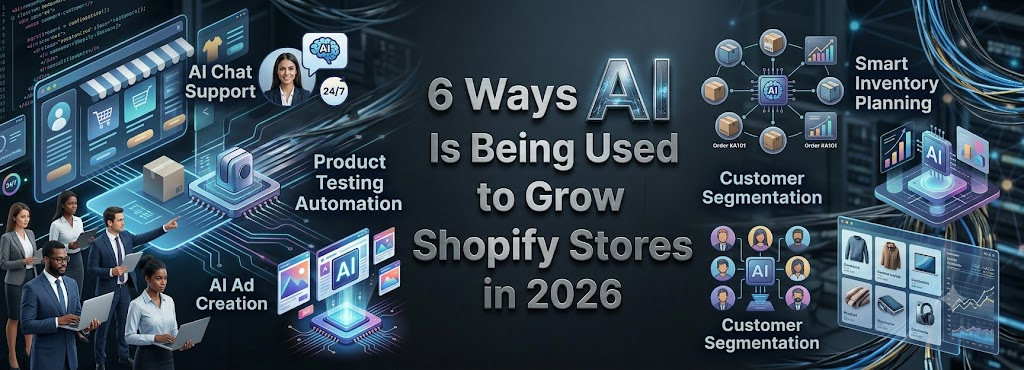
The list of practical AI applications for Shopify stores keeps expanding. Here are six ways teams put it to work right now:
- AI-powered chatbots handle common customer support questions around the clock
- Automated A/B testing runs on product pages without constant manual setup
- AI-generated ad copy and creative variations speed up campaign testing
- Predictive analytics guide inventory planning based on real demand signals
- AI-assisted customer segmentation groups shoppers by actual behavior patterns
- Automated reporting dashboards tie performance data back to real business goals
Each of these tools solves a specific bottleneck that used to eat up hours of manual work. Together, they free up a team’s time for the kind of strategic thinking that actually drives growth instead of routine tasks that a well-configured system can handle on its own.
How a Shopify Development Partner Balances AI Speed With Brand Quality
Speed means nothing if it comes at the cost of brand identity. A trustworthy Shopify development partner uses AI to accelerate execution while keeping a human review step built into every deliverable. This catches generic or off-brand output before it ever reaches a live store.
Avoiding AI-sounding content and design takes deliberate effort. Teams that skip the review step often end up with copy that reads flat or visuals that feel templated. WillShall Consulting handles this by treating AI as a starting point for drafts and concepts, then applying real editorial and design judgment before anything goes public, a process that keeps client stores from ever looking like a generic template.
Why a Shopify SEO Agency Uses AI to Improve Search and AI Search Visibility
Search behavior has changed. Shoppers now ask AI-powered search tools direct questions instead of typing short keyword strings into Google. A capable Shopify SEO agency uses AI to cluster keywords and spot content gaps faster than manual research ever could, which means content plans stay ahead of what shoppers are actually searching for.
Structured data also plays a bigger role now, since it directly supports how AI search tools pull and summarize content. AI tools speed up the process of identifying technical SEO issues too, flagging broken schema or slow pages that would otherwise take a manual audit days to catch. This combination keeps a store visible across both traditional search results and newer AI-generated summaries.
How a Shopify SEO Company Uses AI Without Losing Content Quality
Using AI for content does not mean skipping human involvement. A solid Shopify SEO company uses AI for drafting and initial research, which speeds up the early stages of content production. Human editors then step in to check accuracy, adjust tone to match brand voice, and confirm the content actually says something original.
Fully automated content strategies tend to underperform over time. Search engines and AI search tools increasingly reward content that shows real expertise and a distinct point of view, not generic text that reads the same as a hundred other pages. The agencies producing the strongest results keep a human editor in the loop on every piece before it publishes.
How AI Tools Help Track Performance Across Google and AI Search Platforms
Tracking performance used to mean checking rankings in Google alone. Now teams also monitor how often a brand shows up inside AI-generated summaries and answers, since that visibility increasingly drives traffic on its own. AI tools make it possible to track both signals side by side instead of treating them as separate projects.
Combined performance data changes how a team adjusts strategy, too. A page that ranks well in Google but never appears in AI summaries might need different structured data or clearer, answer-focused content. Watching both channels together gives a more complete picture of where a store actually stands.
Comparison Table: AI-Only Content Strategy vs AI-Assisted, Human-Reviewed Strategy
| Factor | AI-Only Strategy | AI-Assisted, Human-Reviewed Strategy |
|---|---|---|
| Content Quality | Often generic and repetitive | Original, matches brand tone |
| Brand Consistency | Inconsistent across pages | Consistent, guided by editorial review |
| SEO Effectiveness | Short-term gains, unstable long-term | Steady, sustainable growth |
| Risk of Errors | Higher, factual mistakes slip through | Lower, caught during review |
| Long-Term Trust Signals | Weaker, search engines detect patterns | Stronger, builds real authority |
What to Look for in a Shopify Agency That Uses AI Responsibly
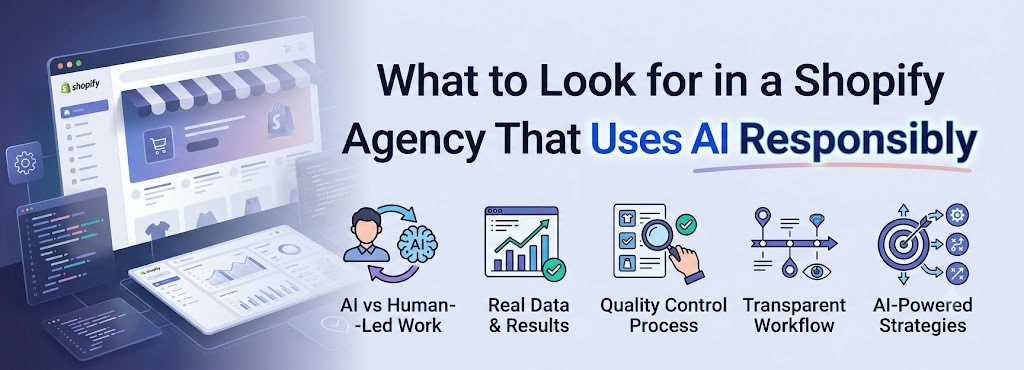
Not every agency claiming to use AI actually applies it well. Look for transparency about what gets automated and what stays human-led, since vague answers usually signal a lack of real process. A strong agency can show specific examples of AI-assisted results backed by real data, not just general claims about efficiency.
Quality control matters just as much as the AI tools themselves. Ask how a team catches mistakes before they reach a live store or a published article. An agency that explains its review process clearly, step by step, usually has a more mature approach than one that simply says AI handles everything.
5 Questions to Ask Before You Hire Shopify Expert Help for AI-Driven Growth
Before committing to any agency, a few direct questions can save a lot of frustration later:
- Which parts of the process use AI and which stay human-led?
- How do you measure AI-driven results across a store?
- Can you show real examples of AI-assisted store growth?
- How do you keep brand voice consistent when using AI tools?
- How does your team stay current as AI tools keep evolving?
Straight answers to these questions reveal a lot about how an agency actually works. Vague or overly technical responses often mean the team has not thought through its own process carefully enough to explain it in plain terms.
What Realistic Results Look Like When AI Is Used the Right Way
AI does not turn a struggling store into a bestseller overnight. What it does deliver is faster testing and iteration, so a team learns what works in weeks instead of months. Personalization efforts tend to produce steady, incremental conversion gains rather than one dramatic jump, which adds up meaningfully over a full year.
Efficient reporting frees up real time too. Instead of a team spending hours pulling numbers together, that time goes toward strategy and creative work that actually grows the business. These realistic, compounding gains matter more long-term than any single flashy result.
Closing Thoughts
A skilled Los Angeles Shopify agency uses AI to move faster and think smarter, not to replace the strategy and judgment that real growth requires. AI works best paired with experienced human oversight, especially in a competitive market where shoppers expect a fast, personalized experience. WillShall Consulting has built its Shopify and marketing work around exactly this balance, combining AI-powered tools with hands-on strategy to help stores grow with intention rather than guesswork.
Get a free Shopify AI strategy consultation or request a custom quote to see what a smarter approach could do for your store.
With a Bachelor’s in Commerce and 15 years of experience in Ecommerce SEO and Shopify Development, I bring extensive expertise to the digital field. As Managing Partner at WillShall Consulting, I lead a team delivering exceptional Digital Marketing, Web Development, and Web Designing services. My passion for innovation and commitment to excellence help businesses thrive in the digital age.
Frequently Asked Questions About Los Angeles Shopify Agency

Looking to boost your online presence and reach more customers in your local area?
Explore Local SEO ServiceKnow your website’s SEO Score.
Get a customize SEO Audit report & improve your website statistics.