Websites used to be static things. A designer built a layout. A developer coded it. It stayed that way for months, sometimes years. Nobody measured how long visitors stayed. Nobody tested whether it worked on a phone. That approach no longer works.
AI now drives how businesses plan, build, and improve their websites. It analyzes visitor behavior, automates performance fixes, personalizes content for different audience segments, and surfaces technical problems before they damage search rankings. What once required weeks of manual analysis now takes minutes.
But AI alone does not build a great website. The foundation still determines the outcome. A fast, clean, well-structured site remains the base requirement for everything that follows. This is why responsive web design serviceshave become a genuine business investment rather than a technical formality. AI has made that investment far more powerful than it ever was before. This article covers how businesses apply AI across different areas of web design, what the real benefits look like in practice, and where the industry is headed next.
Get a Free AI-Powered Website Audit
Discover Hidden Opportunities to Improve User Experience and Increase Conversions
A responsive website reads the screen, displays it, and adjusts accordingly. The layout shifts. Images resize. Navigation restructures. The visitor gets a clean, functional experience whether they arrive on a laptop, tablet, or phone.
Four components make this work:
Flexible grids that redistribute column widths based on available screen space
Responsive images that scale proportionally without pixelating or overflowing containers
Adaptive layouts that reorder content blocks to suit smaller displays
Mobile-friendly navigation that stays accessible without the visitor needing to pinch or zoom
More than half of all global web traffic now comes from mobile devices. A business that ignores this loses customers before a single conversation begins. There is also a direct SEO consequence. Google evaluates the mobile version of a site when it assigns search rankings. A site that performs poorly on phones ranks lower, full stop, regardless of how polished the desktop version looks.
The Evolution of Web Design: From Static Pages to AI-Powered Experiences
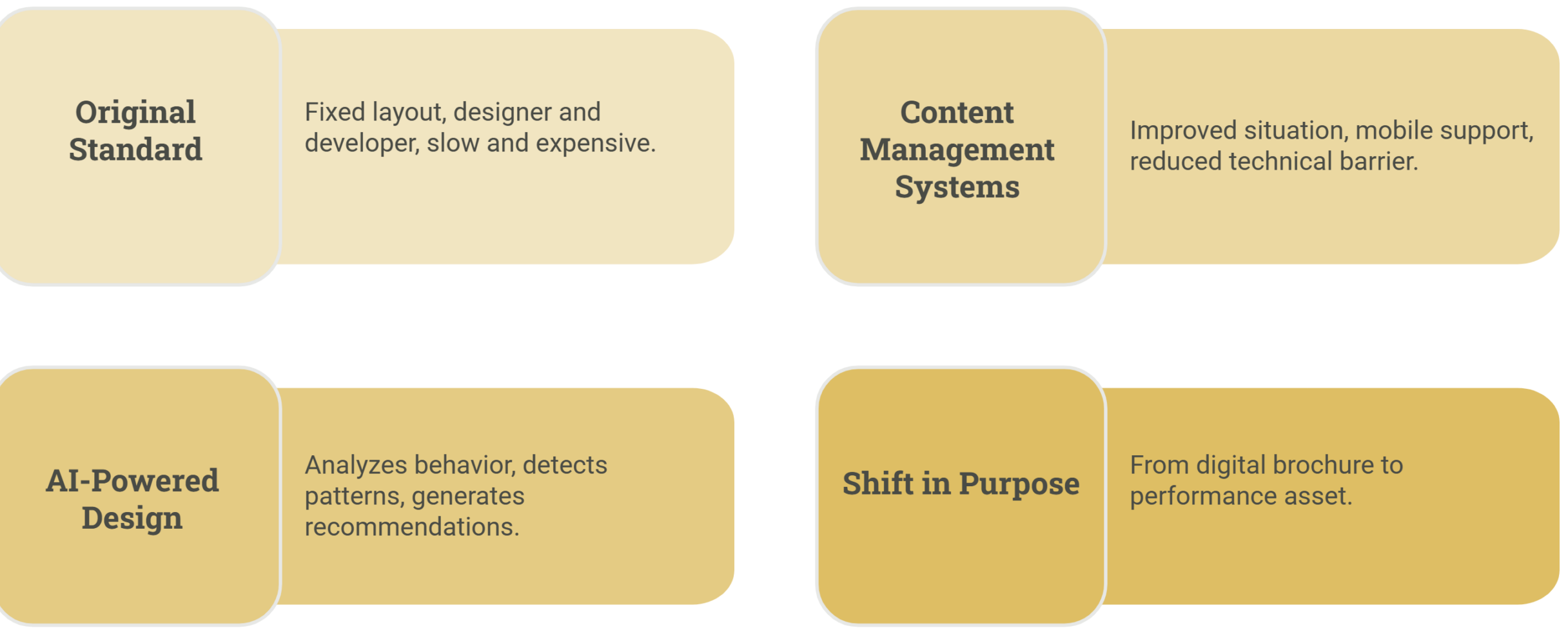
The original standard was a fixed layout. A designer produced it. A developer built it. It sat there until someone paid to change it. The process was slow, expensive, and produced results based on guesswork rather than data. Content management systems improved the situation. Responsive frameworks made mobile support more practical. Drag-and-drop builders reduced the technical barrier further. But every one of those tools still depended on human decisions made with incomplete information.
AI changed the entire decision-making process. Machine learning models now analyze visitor behavior across thousands of sessions, detect patterns no human team could spot manually, and generate recommendations fast enough to act on them in real time. A website powered by AI does not just look better. It performs better because every decision draws from real data rather than professional instinct.
This shift from static to intelligent design reflects a broader change in what a website is supposed to do. It is not a digital brochure. It is a performance asset that should improve with every week it operates.
How Artificial Intelligence Is Transforming Responsive Web Design Services
AI brings specific, measurable capabilities to modern web design. Businesses use these actively, not theoretically.
AI Capability
What It Does in Practice
Automated design recommendations
Suggests layout changes based on where users click, scroll, and stop reading
Real-time content adaptation
Adjusts displayed content based on visitor profile and live behavior signals
User behavior prediction
Identifies which visitors are most likely to convert and surfaces relevant content for them
Personalized experiences
Delivers different content to different audience segments without manual setup
Continuous optimization
Tests and refines page elements around the clock without human intervention
The practical outcome is a website that gets better over time on its own. AI identifies which headlines generate action, which calls-to-action get scrolled past, and which page structures hold visitor attention longest. Each data point becomes a signal for the next round of improvement. Businesses that still rely on manual testing and gut instinct cannot match that iteration speed.
How AI Improves User Experience (UX) Across Devices
Every visitor who lands on a website has one goal: to find what they need without friction. When navigation confuses them, or content feels irrelevant to their situation, they leave. They rarely come back.
AI reduces that friction by constructing personalized user journeys from actual behavior data. It tracks how visitors move through a site, pinpoints the exact moments they abandon a page, and adjusts the experience to remove those barriers. A returning visitor sees something different from a first-time visitor because the system recognizes that difference and acts on it.
Dynamic content presentation puts the right message in front of the right person at the right stage of their decision. Intelligent navigation systems learn which paths through a site lead to conversions and surface those paths more prominently over time. The results appear in numbers. Bounce rates fall. Time on site increases. Conversion rates climb. None of this happens randomly. AI drives each adjustment with specific data behind it.
AI and Website Speed Optimization
Fitting a desktop design onto a smaller screen is not mobile optimization. That approach produces a frustrating experience that drives visitors away.
Real AI-powered mobile optimization works at a deeper level:
Smart image compression
cuts file sizes without any visible reduction in quality
Adaptive typography
adjusts font sizes and line spacing so text stays readable on small screens without zooming
Device-specific content delivery
sends optimized assets based on actual screen resolution and connection speed
Automated performance enhancements
compress code, defer non-critical scripts, and prioritize above-the-fold content so pages feel fast from the first second
Mobile-first optimization
tests the mobile experience continuously and flags issues before they affect rankings or visitor satisfaction.
A one-second delay in page load time reduces conversions by up to 7%. AI removes the guesswork from mobile performance management entirely and replaces assumptions with data that reflects how real visitors actually behave on real devices.
Expert insights from
Neha Sharma
Web Developer
“The most effective websites today don’t just adapt to screen sizes; they adapt to user behavior. AI is turning responsive design from a technical requirement into a continuous growth strategy.”
Benefits of AI-Driven Web Design Services for Small Businesses
Most small businesses do not have a dedicated development team. One person handles the website alongside every other business function. That creates a real gap between what the business needs from its website and what it can realistically maintain without outside help. AI narrows that gap in practical ways.
Faster improvements that do not require hiring a developer for every minor change
Better customer targeting built on behavioral data rather than assumptions about who visits and why
Cost-effective optimization that identifies and prioritizes the highest-impact changes first
Improved local search visibility through automated technical SEO adjustments that would otherwise require specialist knowledge
More conversion opportunities through smarter layout decisions and content that matches what each visitor actually needs
A local business with an AI-enhanced website can compete directly with much larger competitors in search results. Five years ago, that was not realistic for most small businesses. Now it is.
How a B2B Web Design Agency Uses AI for Client Growth
A B2B web design agency works with a different brief than one focused on consumer products. B2B websites must appeal to decision-makers who do their research thoroughly, support sales cycles that can last months, and communicate complex value without overwhelming the visitor on the first visit. AI supports this by analyzing how high-value visitors behave on the site. Which content formats hold their attention longest? Which pages do they return to before making contact? Which propositions move them toward a decision?
AI can also adjust landing pages based on the visitor’s industry, company size, or previous interactions with the site. A procurement manager from a manufacturing firm sees different content than a marketing director at a software company, even when both land on the same URL.
Lead scoring becomes automatic. A visitor who reads three case studies and downloads a whitepaper scores higher than one who views the homepage and exits. Sales teams receive better-qualified leads with no manual filtering required. That efficiency builds on itself over time.
Why Businesses Hire Shopify Expert Professionals
Shopify stores carry specific technical requirements that general web developers frequently miss. Businesses that choose to hire Shopify expert developers work with professionals who understand theme architecture, the app ecosystem, and the particular behavior patterns of eCommerce shoppers.
AI adds a new dimension to that expertise. Expert Shopify developers now integrate AI tools that power product recommendation engines, dynamic pricing displays, and predictive inventory management. These additions increase average order values and cut cart abandonment rates without ongoing manual attention. Platform-specific expertise combined with AI capability produces outcomes that neither element delivers on its own.
How a Shopify Web Design Agency Uses AI to Increase Sales
AShopify web design agency that builds AI into its standard workflow delivers measurably stronger results for clients across every stage of the customer journey:
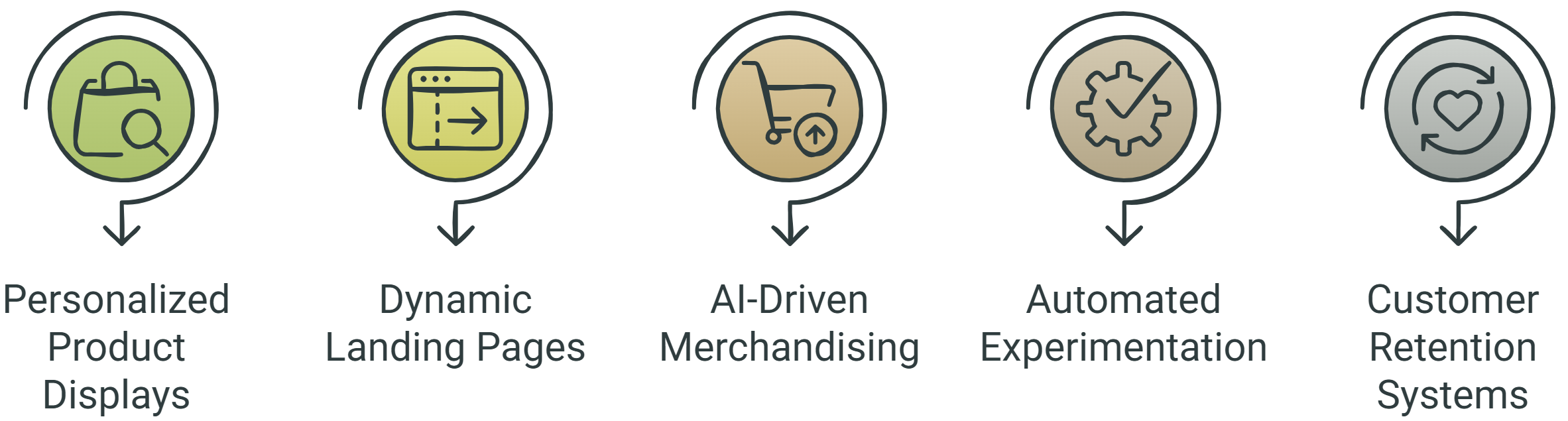
Personalized product displays that change based on each visitor’s browsing history and past purchase behavior
Dynamic landing pages that adjust headlines and offers depending on where the traffic originated
AI-driven merchandising that surfaces bestsellers or high-margin products at the moments of highest purchase intent
Automated experimentation that runs tests across product pages and checkout flows without any manual setup required
Customer retention systems triggered by post-purchase behavior rather than fixed calendar intervals
These capabilities turn a Shopify store from a static product catalogue into a system that learns how to sell more effectively with every transaction it processes.
Why Shopify Experts in Houston Are Leveraging AI
Houston is a competitive, commercially active market with a diverse customer base. Shopify Experts Houston now use AI to help regional eCommerce businesses compete on performance rather than price alone.
Local market data allows AI tools to shape product recommendations and promotional content around the specific buying patterns of Houston shoppers. Competitive separation becomes sustainable when a store adapts to customer behavior faster than rivals who still make changes manually.
Customer experience improvements compound over time. The longer an AI system operates on a Shopify store, the more accurately it predicts what that store’s specific customers want to buy and when.
How a WordPress Web Design Agency Uses AI for Better Results
A WordPress web design agencyhandles a wide range of projects, from content-driven editorial sites to complex membership platforms and multi-location service businesses. AI enhances these projects across multiple dimensions:
AI-assisted content optimization that identifies gaps, flags thin or duplicate material, and suggests structural improvements
Smart design recommendations built on industry benchmarks and real visitor behavior data from comparable sites
Automated SEO enhancements that cover meta tag generation, internal linking suggestions, and schema markup without manual input
Security monitoring that detects threats and flags vulnerabilities before they cause visible damage to the site or its reputation
UX improvements derived from session recordings and heatmap analysis, rather than subjective opinion about what looks good
WordPress powers more than 40% of all websites globally. AI tools built specifically for this platform extend that reach with far greater performance capability than standard themes and plugins deliver on their own.
Affordable WordPress Web Design Meets AI Innovation
Cost has historically separated businesses that could afford advanced web development from those that could not. Affordable WordPress web design combined with AI tools removes that separation for smaller operations. AI reduces development time by automating the repetitive tasks that consume the most hours.
Designers spend less time on manual adjustments and more time on decisions that actually require human judgment. Maintenance requirements drop because AI monitoring catches problems before they escalate into expensive fixes. Scalability improves because AI-driven architecture handles traffic growth rather than buckling under it. The long-term value of an AI-enhanced WordPress site typically exceeds its initial build cost well within the first year of operation.
The Relationship Between Responsive Design and AI SEO Services
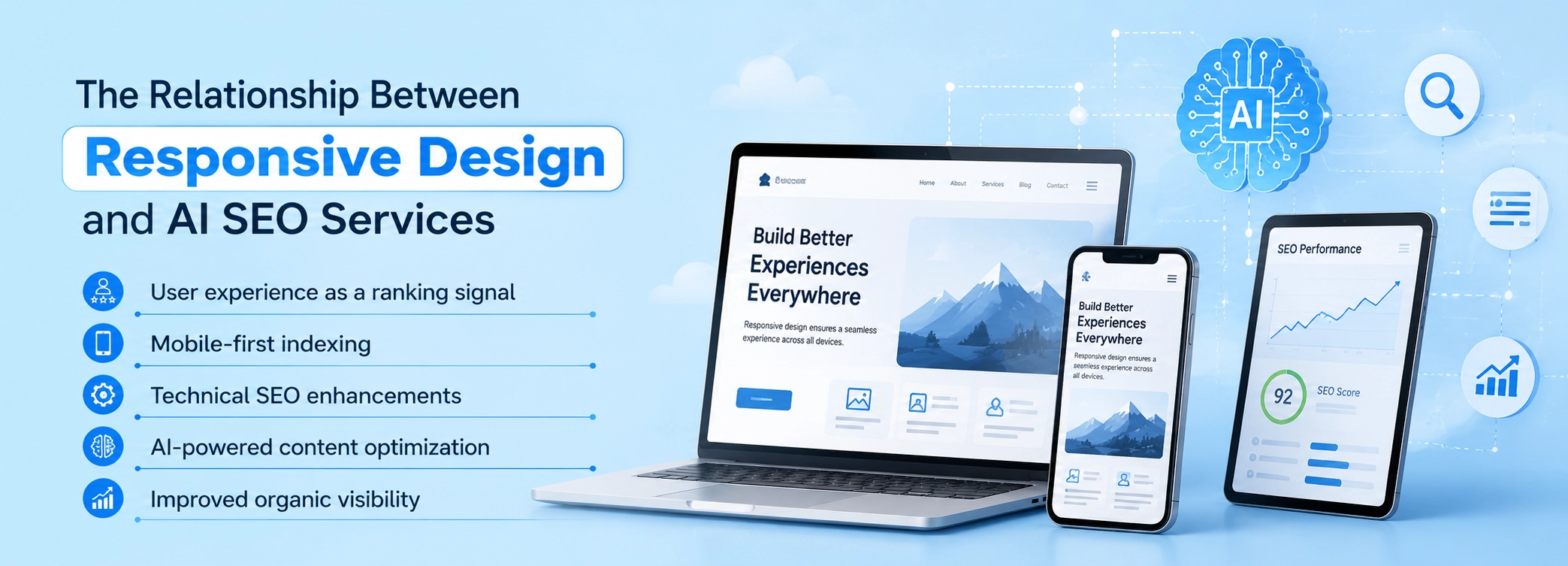
AI SEO services and responsive web design function as a single integrated system, not two separate efforts that happen to share a server.
A mobile-optimized site satisfies Google’s Core Web Vitals requirements. AI SEO tools monitor those signals on a continuous basis and surface technical fixes before they become ranking problems. User experience functions as a ranking signal directly. Google tracks dwell time, bounce rates, and interaction depth on every page it indexes. A website that holds visitor attention longer signals relevance and authority. AI-powered responsive design improves those engagement metrics, which raises organic visibility in measurable ways.
The relationship runs in both directions. Strong, responsive web design services make SEO easier to achieve. Strong AI SEO analysis makes web design decisions more data-driven and purposeful. Together, they produce results that neither discipline delivers when it operates in isolation.
How an AI SEO Agency Complements Responsive Web Design
An AI SEO agency brings analytical depth that amplifies strong design work. The combination produces compounding results rather than two parallel efforts that never quite connect.
Standalone Approach
Combined AI SEO and Responsive Design
Design focuses on visual appearance
Design decisions informed by real search and behavior data
SEO is handled separately after launch
SEO is built directly into design choices from the start
Results reviewed manually on a fixed schedule
AI monitors performance continuously and adapts in real time
Slow iteration cycle between updates
Fast, data-driven improvements at every stage of operation
When design teams and SEO specialists share AI-generated insights from the same data sources, every decision serves both the user experience and search performance at the same time. Traffic grows. Conversions follow that growth. The two outcomes reinforce each other rather than competing for priority.
Responsive Web Design Services vs Traditional Website Design
Feature
Responsive Web Design Services
Traditional Website Design
Mobile Experience
Excellent across all devices
Limited and often broken on phones
User Experience
Adaptive and personalized
Static and one-size-fits-all
SEO Performance
Strong, meets mobile-first standards
Moderate, often penalized by Google
Conversion Potential
Higher due to relevant, targeted experiences
Lower due to friction and poor mobile flow
Maintenance
Easier with AI monitoring in place
More complex and more expensive over time
Scalability
High adapts to traffic and business growth
Limited by fixed architecture
Customer Satisfaction
Measurably better across all audience segments
Average at best
Pros and Cons of Using AI in Responsive Web Design
Pros:
Faster optimization with significantly less manual effort at every stage
Better personalization built on actual user data rather than demographic assumptions
Improved analytics that surface behavioral patterns human review would miss entirely
Greater efficiency across design, development, and ongoing maintenance workflows
Enhanced customer experiences that drive retention and reduce the cost of acquisition over time
Cons:
Initial setup costs can run higher than traditional builds in some project contexts.
AI requires quality data to produce reliable recommendations; poor data leads to poor outputs.
Human oversight remains essential to validate what the system produces and catch errors
Privacy considerations require careful, documented data collection and handling policies
Common Mistakes Businesses Make When Implementing AI
AI adoption fails when businesses approach it without clear objectives. The technology is capable. The strategy is often not.
Common mistakes that undermine AI implementation:
Over-reliance on automation without reviewing outputs at regular intervals to catch errors or drift
Ignoring customer feedback in favor of algorithmic recommendations that miss qualitative signals
Poor data collection that corrupts AI analysis from the very start of the project
Neglecting UX fundamentals and building AI-powered features on a weak structural foundation
Failure to measure results against defined business goals rather than surface-level vanity metrics
AI performs best when humans set clear objectives, provide clean data, and apply critical judgment to what the system recommends.
Emerging Trends in AI-Powered Responsive Web Design
The next generation of AI web design capabilities is already in active development across the industry:
Predictive personalization that anticipates what a visitor needs based on behavioral signals before they consciously express a preference
Voice-first interfaces that make navigation accessible to users who prefer to speak rather than click or type
AI-generated design systems that produce consistent visual identities across hundreds of pages without manual repetition
Real-time adaptive websites that restructure content and layout based on live visitor signals rather than scheduled updates
Hyper-personalized customer journeys that treat every visitor as a distinct individual rather than a member of a broad demographic segment
Businesses that adopt these capabilities early build advantages that competitors using static, manually managed sites cannot close quickly.
Measuring ROI From AI-Powered Responsive Web Design
Return on investment from AI-enhanced web design shows up in concrete, trackable business numbers:
Increased lead generation from stronger conversion paths and improved organic search performance
Higher conversion rates through personalized calls-to-action and optimized user journeys that match visitor intent
Reduced bounce rates as AI identifies and removes friction from every key stage of the visitor experience
Better customer retention through post-visit personalization and behavior-triggered re-engagement that brings visitors back
Long-term revenue growth as compounding optimizations deliver sustained gains rather than a single one-time improvement
Every metric connects directly to the quality of the underlying website structure and the intelligence applied to it over time.
Conclusion: Why AI-Powered Responsive Web Design Is the Future
AI has permanently changed what a website can accomplish for a business. Responsive web design services now extend well beyond mobile compatibility into genuine personalization, behavioral analysis, predictive optimization, and continuous performance improvement that never stops.
Businesses that take this seriously gain advantages that build on themselves. Better user experiences drive stronger engagement. Stronger engagement improves search rankings. Better rankings attract more qualified traffic. More traffic, properly converted, grows revenue in a way that compounds across every quarter.
WillShall Consulting has built its practice at this exact intersection, combining deep technical web design expertise with AI-driven optimization strategies to help businesses create digital experiences that perform consistently across every device, every audience segment, and every stage of the customer journey.
The question is no longer whether AI belongs in web design. It does, without question. The only question worth asking is how quickly a business chooses to act on that reality.
Ready to Future-Proof Your Website?
Partner With WillShall Consulting for AI-Powered Responsive Web Design That Delivers Real Results
I bring a wealth of knowledge and experience to WillShall Consulting with two decades of expertise in Website Design, Development, and Digital Marketing, My journey has been marked by a passion for creating innovative web solutions that not only meet but exceed client expectations. As an avid analyst, I dedicate myself to understanding each customer’s unique needs, ensuring that our web solutions are not just functional but exceptional.
Frequently Asked Questions about Responsive Web Design Services
Responsive web design services ensure a website adapts its layout and content to work correctly across all screen sizes, from large desktop monitors to small mobile phones, without requiring a separate mobile version of the site.
AI analyzes real visitor behavior, automates performance testing, personalizes content delivery for different audience segments, and continuously optimizes layouts and conversion paths based on live data rather than periodic manual review.
Google uses mobile-first indexing, which means it evaluates the mobile version of a site when it assigns search rankings. Poor mobile performance directly reduces organic visibility regardless of how well the desktop version performs.
Yes. AI tools make advanced optimization accessible at a cost that small businesses can realistically afford, helping them compete with much larger competitors through smarter performance decisions and more relevant visitor experiences.
Shopify Expert developers bring platform-specific knowledge that covers custom theme architecture, app integrations, and AI-powered eCommerce features that increase sales, raise average order values, and reduce cart abandonment rates.
A Shopify web design agency uses AI to personalize product displays, automate experimentation across key pages, optimize landing pages by traffic source, and build customer retention workflows that activate based on real shopper behavior.
Yes. AI reduces development time and ongoing maintenance costs, which makes advanced features achievable within tighter budgets without sacrificing quality, performance, or the ability to scale as the business grows.
AI SEO services monitor Core Web Vitals, automate technical fixes, identify content gaps, and align website performance with the specific signals Google uses to determine where a site ranks in organic search results.
I bring a wealth of knowledge and experience to WillShall Consulting with two decades of expertise in Website Design, Development, and Digital Marketing, My journey has been marked by a passion for creating innovative web solutions that not only meet but exceed client expectations. As an avid analyst, I dedicate myself to understanding each customer's unique needs, ensuring that our web solutions are not just functional but exceptional.





 Upwork
 Fiverr
 People Per
Hour
People Per
Hour
 By Manoj Kandwal
|
22-Jun-2026
By Manoj Kandwal
|
22-Jun-2026