Three of the most recommended website platforms, three completely different sets of strengths, and no shortage of conflicting opinions online. Ask ten business owners which platform wins, and you get ten different answers, usually based on whatever platform they happen to use themselves. The real issue is that Shopify vs. WordPress vs. Wix is not a question with one universal answer. The right platform depends on your business type, your goals, and your technical needs. This guide breaks down each platform honestly so you can choose with confidence in 2026.
Ready to figure out which platform actually fits your business?
Book a free platform selection consultation and get a straight answer instead of a sales pitch.
Shopify exists for one purpose: selling products online. The platform gives store owners a checkout process that converts well, payment processing that handles most major methods out of the box, and inventory tools built specifically for retail. None of this needs a developer to configure on day one.
As a store grows, Shopify scales with it. Businesses that start with a handful of products can expand into thousands of SKUs, multiple currencies, and international shipping without switching platforms. That growth path is one reason Shopify remains the default choice for serious e-commerce brands.
What WordPress Is Built For
WordPress started as a blogging tool and grew into the most flexible content management system available. Businesses that publish articles, run resource libraries, or need full control over how content looks and reads tend to gravitate toward it.
The plugin and theme ecosystem is what sets WordPress apart. Nearly any feature a business wants, from booking calendars to membership portals, already exists as a plugin. That flexibility comes paired with strong SEO control, which makes WordPress a natural fit for businesses that compete on content and search visibility rather than product catalogs.
What Wix Is Built For
Wix solves a different problem: getting a decent-looking website live fast, without hiring anyone or learning code. The drag-and-drop editor lets a business owner place text, images, and buttons exactly where they want them, and the platform handles hosting and security behind the scenes.
This makes Wix a strong fit for small businesses, solo practitioners, and anyone who needs a simple site rather than a complex one. A local service business or a personal portfolio can go from nothing to a live site in an afternoon, which is not something Shopify or WordPress can promise without extra setup time.
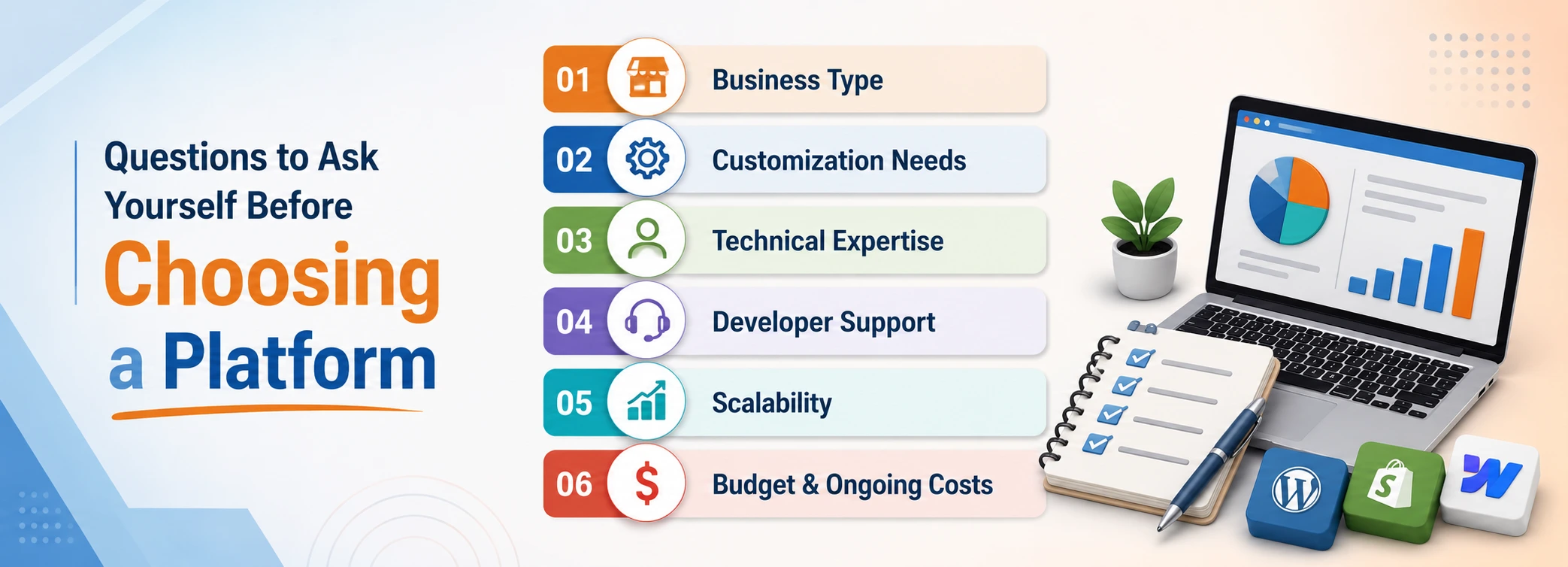
5 Questions to Ask Yourself Before Choosing a Platform
Before comparing platforms feature by feature, answer these questions honestly. The answers usually point toward one platform more than the others.
Is your business primarily e-commerce, content-driven, or informational
How much customization and control do you actually need
What is your technical comfort level or access to developer support
How important is long-term scalability to your plans
What is your realistic budget for setup and ongoing costs
Shopify vs. WordPress: Which Wins for E-commerce
Shopify was built for selling. WordPress needs a plugin called WooCommerce bolted on to do the same job, and while WooCommerce is capable, it asks more of the site owner in terms of setup and maintenance.
Shopify handles updates, security patches, and payment compliance automatically. WordPress with WooCommerce puts that responsibility on the business or its developer. For a growing product catalog, Shopify tends to stay faster and more stable without constant plugin management, which is a real advantage as order volume climbs.
Shopify vs Wix: Which Wins for Small Online Stores
For a very small store selling a handful of products, Wix can work fine. Its e-commerce tools are simpler than Shopify’s, which means less to learn but also less room to grow.
Shopify offers a deeper feature set: abandoned cart recovery, advanced shipping rules, multi-channel selling, and a much larger app marketplace. A store that plans to stay small might not need any of that. A store with real growth ambitions will likely outgrow Wix and face a migration that Shopify avoids from the start.
WordPress vs. Wix: Which Wins for Content and Flexibility?
WordPress wins on customization. Its plugin ecosystem lets a site do almost anything, and full access to code means no ceiling on what a business can build over time.
Wix has an easier learning curve, and for a non-technical user, that matters. The tradeoff shows up later. As a business grows and its needs change, WordPress bends to fit new requirements, while Wix can start to feel restrictive once a business outgrows its templates.
Shopify vs. WordPress vs. Wix Core Features
Feature
Shopify
WordPress
Wix
Ease of use
Moderate
Moderate to advanced
Easiest
Ecommerce capability
Strongest, built in
Strong with WooCommerce
Basic to moderate
Customization depth
Moderate
Deepest
Limited
Scalability
High
High
Low to moderate
Typical cost range
Monthly plan plus apps
Hosting plus plugins, variable
Monthly plan, mostly fixed
Expert insights from
Puneet Bakshi Web Developer
“The best platform question is really a best-fit question,” Sachin Sharma. “Shopify, WordPress, and Wix are all excellent at what they were built to do. The mistake is picking one because it worked for someone else’s business instead of looking at your own goals first.”
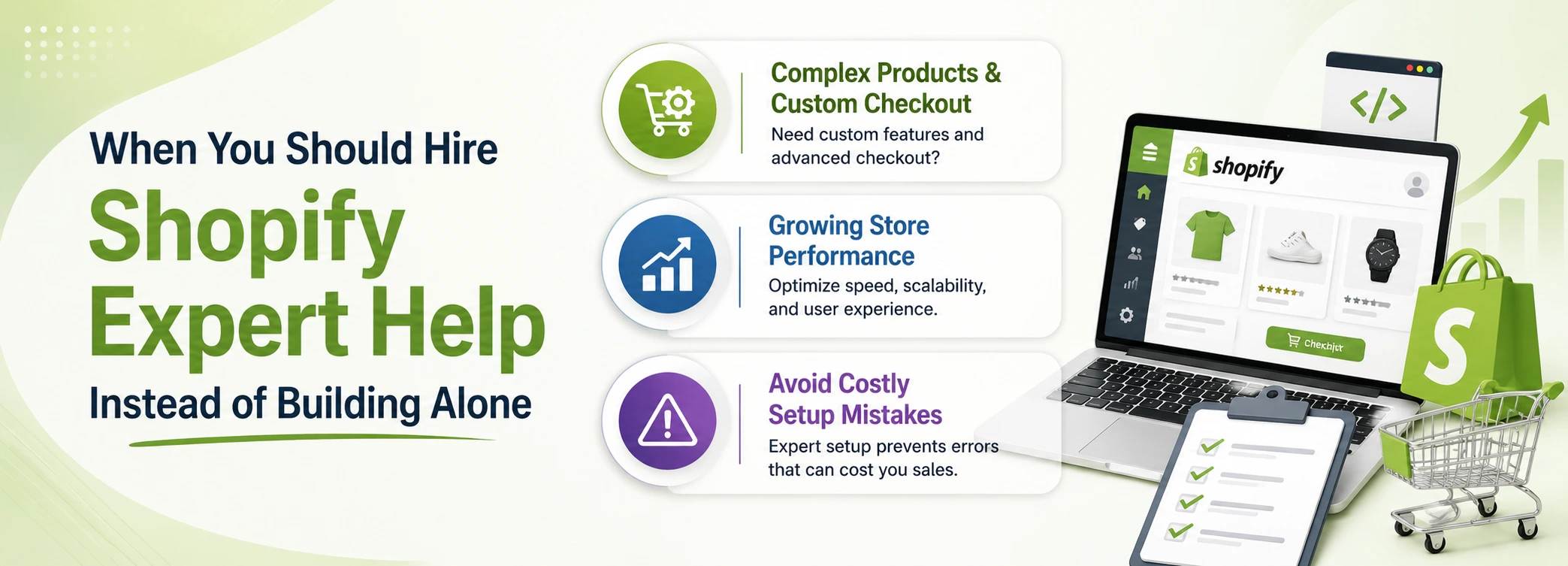
When You Should Hire Shopify Expert Help Instead of Building Alone
A basic Shopify store is easy enough to set up solo. Complex product catalogs, custom checkout flows, or integrations with outside systems are a different story, and this is where it makes sense to hire Shopify expert support rather than guess.
Growing stores also run into performance issues that are hard to diagnose without experience. A slow-loading product page or a checkout that drops customers midway through often traces back to a setup mistake that a self-taught build never catches until it starts costing real revenue.
What a Shopify Developer Actually Adds to a Growing E-commerce Business
A skilled Shopify developer builds functionality that goes beyond what any theme offers out of the box. Custom product filtering, unique checkout logic, and tailored app integrations all fall outside standard theme settings.
Technical troubleshooting is the other piece. When something breaks on a live store, every hour of downtime costs sales. A developer who understands Shopify’s backend can isolate the problem fast and keep the store running while the business keeps selling.
Why Expert Shopify Developers Are Often Worth the Investment for Serious Ecommerce
Working with expert Shopify developers usually gets a store to a fully optimized state faster than a DIY approach ever could. What might take a business owner weeks to figure out through trial and error, an experienced developer handles in days.
That speed matters because technical issues left unresolved cost real money. A checkout bug or a broken app integration can quietly drain revenue for weeks before anyone notices. Developers who plan for scale from the start also save a business from painful rebuilds later.
When WordPress Development Services Make Sense Over a DIY Build
Basic WordPress sites are simple enough for a business owner to manage. Once a project calls for custom functionality beyond what a theme offers, WordPress development services become worth the investment.
Custom integrations, membership features, and security needs beyond what a typical plugin handles all fall into this category. A business running sensitive customer data or complex workflows benefits from a developer who understands WordPress at a deeper level than the average plugin can reach.
What WordPress Website Development Services Typically Include
WordPress website development services generally start with custom theme design, built to match a brand rather than relying on a generic template. From there, plugin selection and configuration shape how the site actually functions day to day.
Ongoing maintenance rounds out the service. Security updates, backups, and plugin compatibility checks are easy to ignore until something breaks, which is why many businesses keep a developer on retainer even after launch.
How to Hire WordPress Developers Without Overpaying for Simple Needs
Not every WordPress project needs a full development team. The first step tohiring WordPress developers at a fair price is matching their expertise level to the actual complexity of the project.
Some agencies overbuild simple content sites because complex builds pay more. A business with straightforward needs should get clear scope and pricing before committing to any contract and should feel comfortable asking why a proposed feature is necessary at all.
When Wix Development Services Are Worth Considering Over the Built-In Editor
The built-in Wix editor covers most small business needs, but Wix development services become useful once a business wants something the standard templates cannot deliver.
Businesses chasing a more polished, unique design often hit the limits of drag-and-drop tools fairly quickly. When the built-in editor starts feeling like a bottleneck rather than a convenience, bringing in outside help usually solves the problem faster than fighting the platform alone.
How Shopify SEO Services Address the Platform’s Built-In SEO Limitations
Shopify’s fixed URL structure creates real limits for search optimization, and this is exactly Shopify SEO services earn their keep. Product URLs follow a rigid pattern that a business cannot fully control without technical workarounds.
Technical SEO for product pages also differs from typical blog SEO. Structured data implementation, which helps products show up correctly in shopping search results, needs to be set up correctly from the start rather than patched in later.
Why a Shopify SEO Expert Is Often Necessary for Competitive Ecommerce Niches
In a crowded market, ranking a Shopify store takes more than basic keyword placement. A Shopify SEO expertfocuses on collection and category page optimization, which often gets overlooked in favor of individual product pages.
App-related speed issues are another factor. Every app added to a Shopify store has the potential to slow it down, and slow pages hurt rankings. Ongoing strategy matters too, since competitors and search algorithms both keep changing.
How WordPress’s SEO Flexibility Compares to Shopify and Wix
WordPress gives site owners far more control over site structure than either Shopify or Wix. URL formatting, internal linking, and technical SEO settings are all fully adjustable without fighting platform restrictions.
The plugin ecosystem adds another layer of advanced customization on top of that control. This combination is why WordPress is generally regarded as the strongest platform for businesses that build their strategy around search visibility rather than product sales.
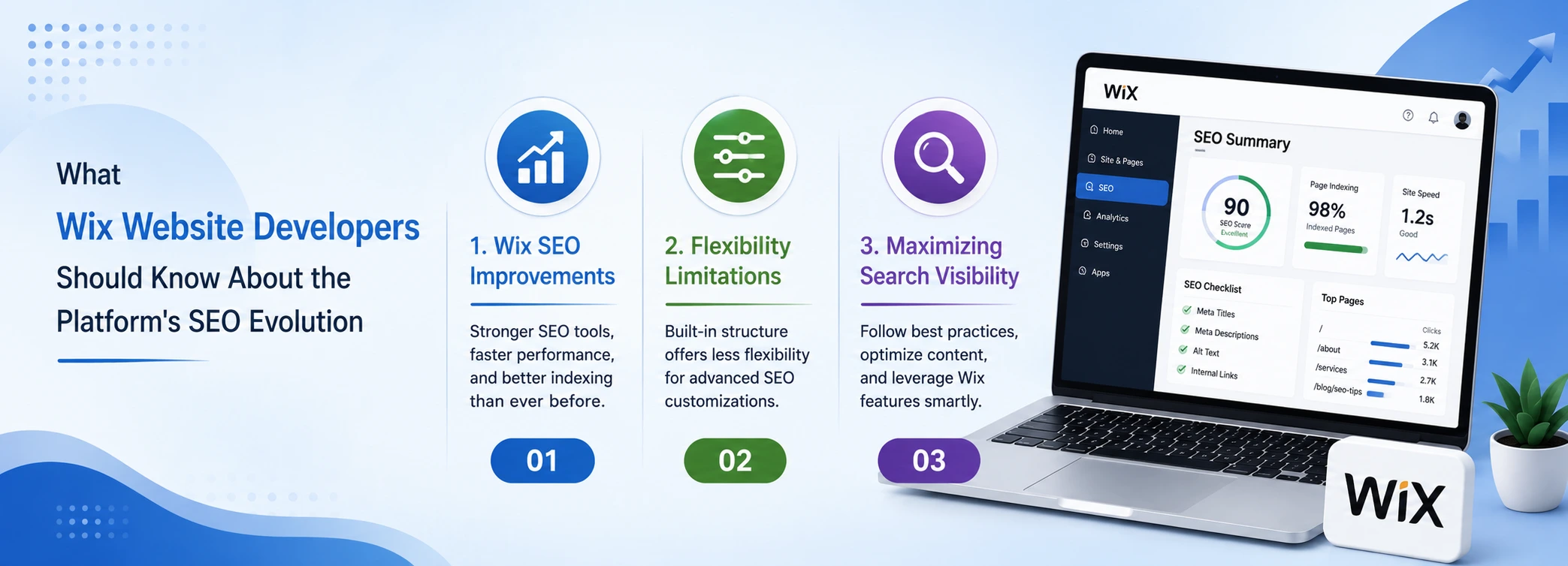
What Wix Website Developers Should Know About the Platform’s SEO Evolution
Wix has made real SEO improvements over the past several years, closing much of the gap that once separated it from WordPress. Wix website developers working on the platform today have far more tools available than they did even a few years back.
Some limitations remain compared to WordPress’s deeper flexibility, particularly around advanced technical SEO. Best practices still apply within Wix’s framework, and developers who know the platform well can maximize visibility despite those remaining constraints.
SEO Capability, Shopify vs. WordPress vs. Wix
SEO Factor
Shopify
WordPress
Wix
URL structure flexibility
Limited
Full control
Moderate
Technical SEO control
Moderate
Strongest
Improved, still limited
Page speed potential
Good, app-dependent
Variable, hosting dependent
Good by default
Content and blogging capability
Basic
Strongest
Moderate
Structured data support
Built in for products
Plugin-dependent, flexible
Built-in, less customizable
Which Platform Makes Sense for a Product-Based Business
For most product-based businesses, Shopify remains the strongest default. Its checkout, inventory, and shipping tools are purpose-built for exactly this kind of operation, and that focus shows in how smoothly a store runs day to day.
WordPress with WooCommerce can still make sense for a business that already has heavy content needs alongside product sales. Wix rarely fits a serious product-based growth plan, since its e-commerce tools cap out well before Shopify’s do.
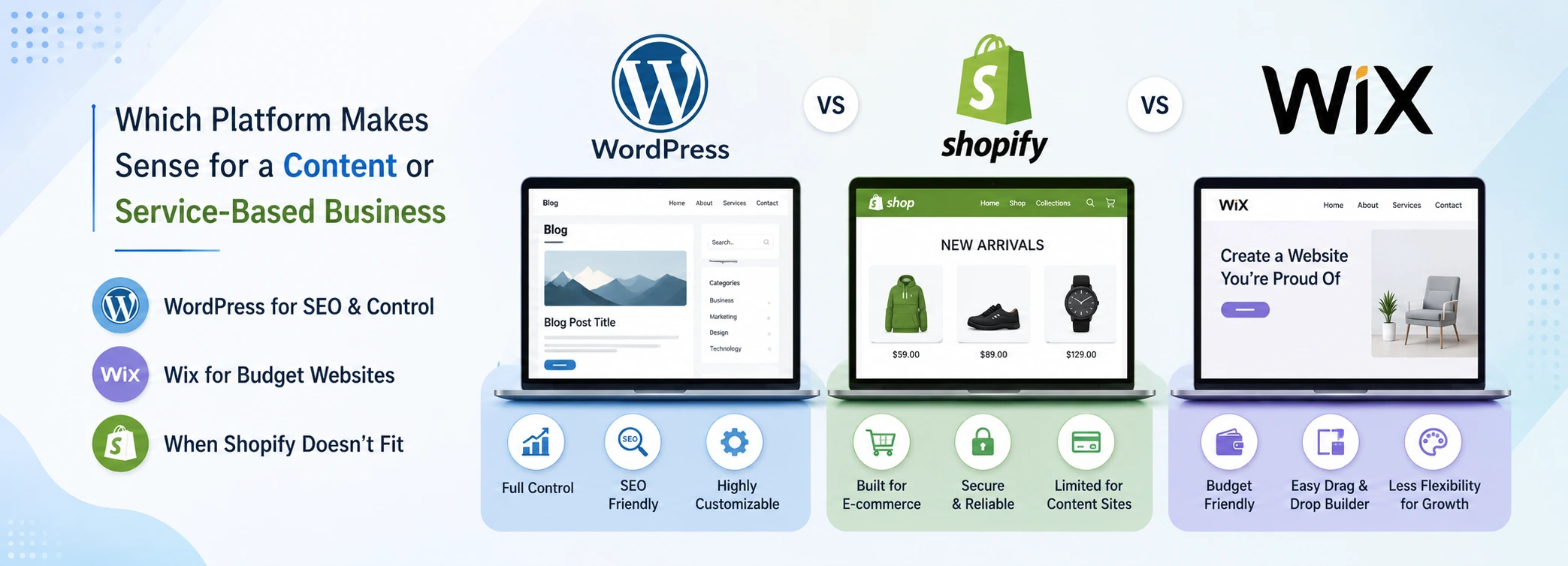
Which Platform Makes Sense for a Content- or Service-Based Business
WordPress is the strongest choice here. Businesses that live or die by search visibility, whether that’s a law firm, a consultancy, or a media site, benefit from the control WordPress offers over content structure and technical SEO.
Wix remains a reasonable option for a simple service site on a tight budget, especially if the business does not plan to scale content aggressively. Shopify would not be the right fit at all for either scenario, since its entire structure assumes products are being sold.
5 Questions to Ask a Developer Before Committing to Any Platform
Before signing a contract with any developer or agency, ask these five questions and pay close attention to how directly they answer.
Do you specialize in this specific platform
Can you show examples of similar businesses you have built for
How do you approach SEO during development
What ongoing support is included after launch
How do you handle scaling if my business grows
How to Know You’ve Chosen the Right Platform for Your Business
The right platform matches your actual business model rather than a trend or a friend’s recommendation. If the platform’s core strengths line up with what your business needs to do daily, that is a strong sign you are on the right path.
Room to grow matters just as much. A platform that forces a full migration the moment a business scales was the wrong choice from the start. Comfort with the platform’s ongoing management demands, whether that means monthly app fees or plugin maintenance, should factor into the decision too.
Closing Thoughts
There is no single winner in the Shopify vs. WordPress vs. Wix debate; only the best fit for a specific business’s goals, budget, and growth plans and the right development partner matter just as much as the platform itself. Agencies such as WillShall Consulting have spent years helping businesses match their platform choice to their actual operations rather than to trends, which is often the difference between a site that grows with a business and one that needs to be rebuilt in a year.
Still weighing your options?
Book a free platform strategy consultation or request a custom quote and get a clear recommendation for your business.
I bring a wealth of knowledge and experience to WillShall Consulting with two decades of expertise in Website Design, Development, and Digital Marketing, My journey has been marked by a passion for creating innovative web solutions that not only meet but exceed client expectations. As an avid analyst, I dedicate myself to understanding each customer’s unique needs, ensuring that our web solutions are not just functional but exceptional.
Frequently Asked Questions About Shopify vs. WordPress vs. Wix
Shopify generally wins for pure e-commerce because its tools are purpose-built for selling, while WordPress needs WooCommerce added on to compete.
Yes, for a simple site with modest goals, Wix covers the basics well and gets a business online quickly.
Costs vary by project complexity, but both typically charge based on scope rather than platform, so simple projects cost less regardless of which platform is used.
Yes, though migration takes time and planning, which is why choosing carefully from the start saves effort down the road.
WordPress generally offers the deepest SEO control, though Shopify and Wix have both improved significantly in recent years.
It can require more hands-on maintenance, but that same flexibility is what gives WordPress its advantage for complex sites.
WordPress usually fits best for content-heavy service businesses, while Wix works for simpler service sites on a budget.
Simple sites can be built solo on any of the three platforms, but complex needs usually benefit from professional help to avoid costly mistakes.
I bring a wealth of knowledge and experience to WillShall Consulting with two decades of expertise in Website Design, Development, and Digital Marketing, My journey has been marked by a passion for creating innovative web solutions that not only meet but exceed client expectations. As an avid analyst, I dedicate myself to understanding each customer's unique needs, ensuring that our web solutions are not just functional but exceptional.





 Upwork
 Fiverr
 People Per
Hour
People Per
Hour
 By Manoj Kandwal
|
24-Aug-2026
By Manoj Kandwal
|
24-Aug-2026