

 Upwork
 Fiverr
 People Per
Hour
People Per
Hour
Get Ahead in 2026 with AI SEO Agency Strategies for Market Leaders
 By Sachin Sharma
|
19-Jun-2026
By Sachin Sharma
|
19-Jun-2026
Search broke. Not slowly, not predictably. Google now puts AI-generated answers at the top of the page before users even see a single website link. Entire traffic streams that brands spent years building have dried up without a single algorithm update announcement.Traditional SEO still plays a role. But a strong keyword ranking means nothing when an AI system decides to answer the question itself and never sends users to your site. The brands that grasped this early are ahead. The ones that did not are watching their organic numbers drop month after month with no clear explanation.
Working with an AI SEO agency gives businesses a real path forward. Not just optimising for crawlers, but getting in front of the AI systems that now control what users see first. This guide covers the full picture: what AI SEO actually involves, why the strongest brands are putting budget behind it, and how to build a search strategy that holds up as AI search continues to mature through 2026 and beyond.
What Is an AI SEO Agency and Why Does It Matter in 2026?
An AI SEO agency works on how search actually functions now, not how it functioned five years ago. That means moving well past keyword rankings and backlink counts to focus on how AI systems read, evaluate, and cite content.
Definition of an AI-Focused SEO Partner
Traditional SEO agencies chase crawlability, link authority, and on-page signals. Those foundations still matter. But AI search engines like Google’s Search Generative Experience, Perplexity, and Bing Copilot work differently. They pull from sources they consider authoritative and well-structured, then generate answers on the spot. Content not built for that retrieval process gets ignored entirely, regardless of how many backlinks point to it.
Differences Between Traditional SEO and AI SEO
Traditional SEO chases ranking positions. AI SEO chases citation. The goal is to become the source that AI systems reference when they construct their answers. That shift changes almost everything about how content needs to be planned, written, and structured.
Role of AI Search Engines and Answer Engines
AI search engines now act as filters between users and websites. They decide what answer surfaces and which brand gets the credit. A citation in an AI result carries more weight than a third-place organic ranking in most competitive markets.
Why Enterprise Brands Are Putting Budget Into AI Optimisation
Enterprise brands worked this out faster than most. They moved the budget into entity optimisation, structured data, and semantic content strategies because the data showed that citation in AI results drove qualified traffic that traditional rankings no longer could.
Future-Proof Your Search Growth Today
Talk to a specialist. Find out where your visibility stands before your competitors move first.
How AI Search Is Changing Digital Marketing Forever
-
Rise of AI-Generated Search Results
AI-generated results now sit above organic listings in a wide range of searches. Users read the answer, get what they came for, and close the tab. Click-through rates on traditional listings have fallen as a direct consequence. This is not a prediction. It is already happening.
-
Evolution of User Search Behaviour
People no longer type keyword strings. They ask full questions. They expect direct, confident answers. Content that performed well because it contained the right keywords now struggles badly if it does not answer the actual question with depth and clarity.
-
Impact of Conversational Search
A single search query can carry multiple layers of intent now. AI systems detect those layers and match them to content that covers the full topic. A page that mentions the right keywords but skirts the actual question gets passed over.
-
Importance of Entity-Based Optimisation
Search engines now maintain knowledge graphs that connect topics, brands, people, and concepts to each other. Brands that appear consistently across those graphs earn authority signals. Those signals directly influence what AI systems choose to surface.
Why Market Leaders Are Investing in AI SEO Services
The brands that committed to ai seo services early now have a measurable gap over slower competitors. That gap is not just about traffic numbers. It is about presence in the places where purchase decisions actually begin.
-
Increased visibility across AI platforms: A citation from an AI system builds credibility faster than any paid placement. Users experience it as a recommendation, not an ad.
-
Better lead generation opportunities: Traffic that arrives from AI citations tends to convert better. The user already received a degree of validation before they clicked.
-
Enhanced customer trust and authority: Consistent AI citation positions a brand as the default authority in its field. That perception compounds over time.
- Competitive advantage in crowded markets: Most sectors still have a large portion of competitors running traditional SEO playbooks. The window to establish AI search authority ahead of them is open, but not indefinitely.
Key Challenges Businesses Face Without an AI SEO Strategy
These problems do not arrive all at once. They build quietly, and by the time most businesses notice, the gap is already wide.
-
Loss of organic visibility: AI-generated answers absorb clicks that used to flow to organic listings. Brands absent from those answers lose exposure even when their ranking position holds steady.
-
Reduced traffic from traditional rankings: A page ranking fourth or fifth below an AI result gets a fraction of the traffic it once did. The ranking position becomes almost irrelevant.
-
Weak AI search presence: Brands not structured for AI retrieval get bypassed entirely. A strong traditional SEO foundation provides no protection here.
- Difficulty establishing topical authority: AI systems favour sources that cover topics with genuine depth. Thin content spread across many topics fails to earn citations, regardless of how well individual pages rank.
Core Services Offered by an AI SEO Agency
A properly built AI SEO company covers a range of interconnected services rather than isolated tactics:
-
AI content optimisation: Content structured so AI systems can parse and cite it. Clear answer formats, logical heading hierarchies, and direct responses to the questions real users ask.
-
Entity SEO implementation: Mapping a brand clearly to the topics, people, and concepts that AI knowledge graphs connect to its industry.
-
Technical AI search optimisation: The structural work that allows AI systems to crawl, understand, and trust a site. Speed, crawlability, internal link structure, and indexing efficiency all feed into this.
-
Generative search visibility enhancement: Specific optimisation work aimed at appearing inside AI-generated summaries and answer panels, not just traditional results pages.
- Structured data deployment: Giving search engines machine-readable signals about what each page covers, who produced it, and why it deserves to be trusted.
How an AI SEO Company Builds a Winning Search Ecosystem
No single optimisation wins AI search visibility. It requires a connected system where every element supports the others.
-
Content Architecture Planning: Topics need organisation that demonstrates both depth and coherence. A cluster of well-connected pages covering a subject from multiple angles outperforms a single strong page every time.
-
Semantic Keyword Mapping: This goes beyond target keywords to map the full range of terms, questions, and related concepts that belong to a topic. It shapes content planning at every level of the strategy.
-
Knowledge Graph Optimisation: This work connects a brand’s entities to the broader web of related information through structured data, consistent author signals, and citations from credible external sources.
- Brand Authority Development: The more a brand appears as a trusted source across credible publications and partner sites, the stronger the signal becomes. AI systems weigh that consistency heavily when deciding what to cite.
Understanding the AI SEO Audit Process
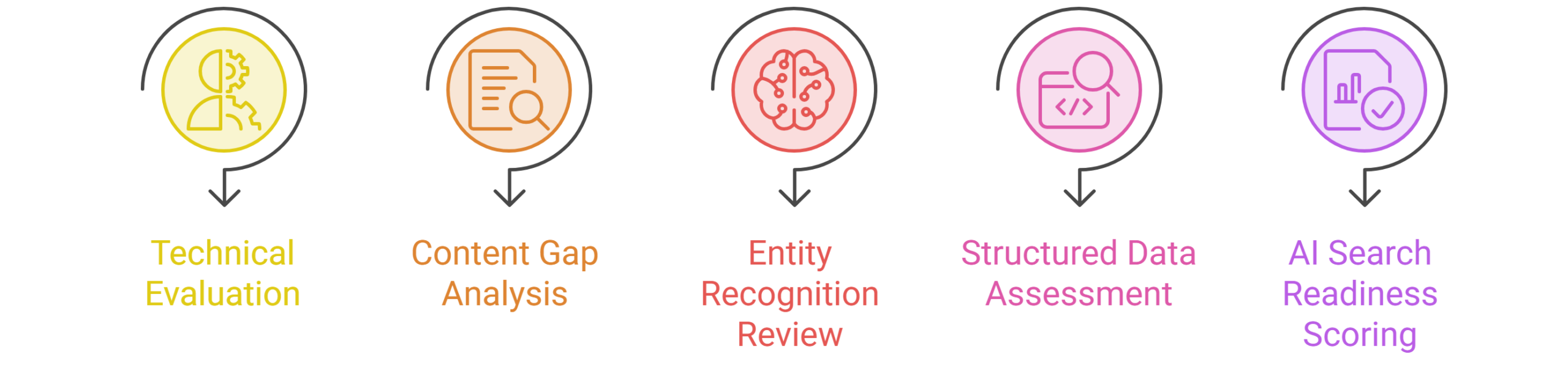
An AI SEO auditis the logical starting point for any serious AI search strategy. It establishes exactly where a site stands and maps the specific gaps preventing AI visibility.
A thorough audit covers:
-
Technical evaluation:
Crawlability, indexing status, page speed, mobile performance, and current structured data implementation. -
Content gap analysis:
Topics the brand should cover but does not, plus existing content that needs significant work to meet AI search standards. -
Entity recognition review:
How clearly search engines can actually identify the brand and its core subject areas from existing signals on the site. -
Structured data assessment:
A full audit of current schema markup and identification of where additional implementation would improve AI readability. - AI search readiness scoring:
A clear, honest picture of where the site sits against current AI search standards and which gaps need to be closed first.
Essential Ranking Factors for AI Search in 2026
These signals consistently determine whether content gets surfaced in AI-generated results:
-
EEAT signals (Experience, Expertise, Authoritativeness, Trustworthiness):
AI systems are built to prefer content from sources with verifiable credibility and demonstrated expertise. Generic content from anonymous sources gets deprioritised. -
Topical authority:
Comprehensive coverage across a subject area outperforms a single well-optimised page. Depth across a topic matters more than depth on a single URL. -
Semantic relevance:
Content that addresses a full topic, including related concepts, supporting questions, and adjacent ideas, performs better than content targeting a single keyword. -
User engagement metrics:
Dwell time, scroll depth, and bounce rate signal that real users find the content valuable. AI systems factor these signals in. - Brand credibility indicators:
External mentions, digital PR coverage, and consistent entity signals across the web all contribute to how AI systems classify a brand’s authority level.
Technical SEO Foundations Required for AI Visibility
AI systems cannot cite content they cannot access. Technical foundations are not optional.
-
Schema markup implementation:
One of the highest-impact technical activities available. Explicit machine-readable signals about what a page covers and who produced it. -
Crawlability improvements:
Every relevant page needs to be accessible. Broken links, redirect chains, and blocked resources reduce what search engines can actually see and evaluate. -
Site speed optimisation:
Affects both user experience and crawl efficiency. Slow sites lose ground across traditional and AI search metrics simultaneously. -
Internal linking strategy:
Creates the topic connections that help search engines build an accurate picture of a site’s content architecture and subject expertise. - Indexing efficiency:
The right pages need to get indexed. Low-value pages dilute the overall signal quality of the domain and should be handled deliberately.
Content Strategies Used by Leading AI SEO Agencies
The content approaches that produce AI visibility share several specific characteristics:
-
Topic clusters:
Content organised around a central subject, supported by connected pieces that address related questions and angles. This structure demonstrates subject depth clearly. -
Content hubs:
A central home for all material related to a specific subject area. It tells search engines that the brand takes a topic seriously enough to invest in it comprehensively. -
Intent-focused content:
Written to match what users actually need at each stage of their decision process, not just what they type. -
AI-friendly formatting:
Clear headings, direct answers, and structured layouts that AI systems can extract from reliably without ambiguity. -
Multi-format content development:
Articles, guides, structured Q and A formats, and video content. AI systems draw from multiple content types when constructing responses.
Unlock Hidden AI Search Opportunities
Get a professional AI SEO audit. Find out exactly where your visibility gaps are before a competitor does.
How AI SEO Consultancy Helps Enterprise-Level Growth
AI SEO consultancy at the enterprise level connects search performance directly to business outcomes rather than treating traffic as an end goal.
-
Strategic Planning
Search strategies need to align with market expansion goals. The question is not just how to rank but which content investments will drive pipeline and revenue growth across AI and traditional search simultaneously.
-
Competitive Benchmarking
Brands need a clear, honest view of where they sit relative to direct competitors and what specific gaps need to be closed. Assumptions without data produce wasted spend.
-
Market Expansion Strategies
AI search creates opportunities to establish authority in adjacent markets and topic areas that traditional SEO has rarely opened up. A consultancy identifies where those opportunities exist and how to capture them efficiently. Technical performance data needs translation into business metrics. Leadership teams make better decisions when they see revenue attribution and customer acquisition cost data, not just keyword ranking reports.
AI SEO Agency vs Traditional SEO Agency
| Feature | AI SEO Agency | Traditional SEO Agency |
|---|---|---|
| AI Search Optimisation | Yes | Limited |
| Entity SEO | Advanced | Basic |
| Generative Search Focus | High | Low |
| Semantic Analysis | Extensive | Moderate |
| AI Visibility Tracking | Included | Rare |
| Future Search Readiness | Strong | Limited |
Technical Statistics and AI SEO Market Trends for 2026
AI-powered search adoption has grown across every major market. More users now interact with AI-generated answers before they click a single website. Brands that invested in AI optimisation report stronger and more durable visibility gains compared to those still running traditional SEO strategies alone.
Structured data implementation consistently ranks as one of the highest-impact technical activities a site can undertake. Content authority, built through depth, consistency, and external citation, remains a primary ranking factor across AI search ecosystems.
Key metrics to track in 2026:
| Metric | What It Measures |
|---|---|
| AI Search Impressions | How often does a brand surface in AI-generated results |
| Citation Frequency | How often do AI systems reference the brand as a source |
| Entity Mentions | Volume and quality of brand references across the web |
| Conversion Rates | Percentage of AI-driven traffic that takes a meaningful action |
| Engagement Metrics | Signals that users find the content genuinely useful |
How the Best AI SEO Agencies Build Topical Authority
The best AI SEO agencies treat topical authority as a long-term asset. Not a campaign. Not a content sprint. A sustained investment that compounds.
-
Content depth strategies:
Every meaningful dimension of a topic needs coverage. Surface-level content does not earn citations from AI systems with access to better sources. -
Industry expertise development:
Author expertise signals need to be visible and verifiable. Bylines, credentials, and consistent publishing across a topic area all contribute. -
Strategic publishing frameworks:
Sustained, consistent output matters more than periodic bursts. A publishing cadence that search engines can rely on builds authority signals over time. - Authority-building campaigns:
Owned content combined with digital PR, structured data, and external citation work ensures the brand shows up consistently in AI knowledge graphs across its core subject areas.
Measuring ROI from AI SEO Service Investments
AI SEO service investment produces measurable returns across several dimensions that matter to business leadership:
-
Traffic growth:
Visits from AI-generated search results increase alongside sustained traditional organic traffic. -
Lead quality improvements:
AI search traffic converts at higher rates because users arrive with stronger purchase intent after receiving AI-sourced validation. -
Revenue attribution:
Direct connection between AI search visibility and pipeline value, not just traffic numbers. -
Customer acquisition cost reduction:
Organic AI search traffic carries no cost-per-click. That improves acquisition economics significantly as volume grows. - Long-term value creation:
Brands with strong AI search authority prove far harder to displace than those dependent on paid channels or ranking positions that shift with every algorithm update.
Common Mistakes Businesses Make When Implementing AI SEO
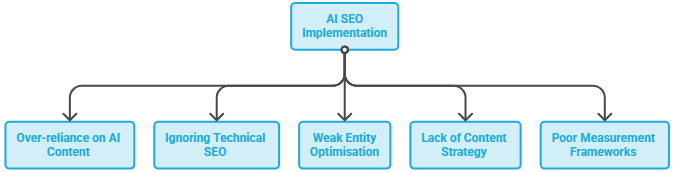
These patterns consistently undermine performance across businesses that attempt AI SEO without a proper strategy:
-
Over-reliance on AI-generated content:
AI systems increasingly detect content that lacks genuine expertise or original perspective. Volume without quality builds nothing. -
Ignoring technical SEO:
No content strategy compensates for crawlability failures, poor indexing, or absent structured data. Technical foundations come first. -
Weak entity optimisation:
Without clear entity signals across structured data and external sources, a brand struggles to appear in knowledge graph results regardless of content quality. -
Lack of content strategy:
Publishing without a clear topic architecture produces isolated pages that never accumulate into coherent authority signals. - Poor measurement frameworks:
Without proper tracking across AI search impressions, citation frequency, and engagement metrics, there is no way to know what works or where to invest next.
Pros and Cons of Hiring an AI SEO Agency
Pros:
- Faster execution of AI search strategies without the cost and time of building internal expertise
- Access to specialist knowledge across entity SEO, structured data, and AI content optimisation
- Better AI search visibility through approaches most in-house teams have not developed yet
- Scalability as search requirements grow alongside the business
Cons:
- Initial investment required before results become visible
- Agency selection demands proper due diligence and time to get it right
- Results need ongoing optimisation as AI search environments continue to shift
Expert Recommendations for Choosing the Best AI SEO Agency
Selecting the right partner for AI SEO consultancy requires more rigour than reviewing a pitch deck. The factors that actually matter:
-
Proven AI search experience:
Demonstrable results specifically in AI-generated visibility, not just traditional ranking reports -
Case studies and success metrics:
Evidence of measurable outcomes in citation frequency, entity recognition, and AI search traffic -
Technical SEO capabilities:
Real capability across schema implementation, crawlability, and indexing efficiency -
Industry expertise:
Relevant knowledge of the specific market and competitive landscape in which the brand operates - Reporting transparency: Clear connection between technical performance data and business outcomes, not just vanity metrics
Industries Benefiting Most from AI SEO in 2026
Certain sectors gain disproportionate advantages from working with the best AI SEO agency:

-
SaaS companies: Buyers research extensively before purchase. Appearing as a trusted AI-cited source during that research phase drives a qualified pipeline directly.
-
E-commerce brands: Product discovery now begins with AI-generated answers in many categories. Brands not present in those answers miss the top of the funnel entirely.
-
Healthcare organisations: AI health information results carry strict authority requirements. Brands that meet them gain significant credibility signals with highly motivated audiences.
-
Financial services: Users making significant financial decisions consult AI-generated information first. Citation in that context carries substantial weight.
- Professional service firms: The questions prospective clients ask AI systems are exactly the questions these firms should be answering with deep, authoritative content.
Future Trends Shaping AI SEO Agencies Beyond 2026
-
AI agents and autonomous search: Automated systems will handle more information gathering on behalf of users. Brands with strong AI citation histories will benefit as this scales.
-
Hyper-personalised search experiences: Results will adapt to individual context and history. Content built for specific user needs will consistently outperform generic material.
-
Knowledge graph expansion: Entity connections will deepen and broaden. Consistent entity signals will become more valuable, not less, as this develops.
-
Predictive search optimisation: Anticipating user questions before they ask them becomes a competitive advantage. Comprehensive topic coverage is the foundation for this.
- Voice and multimodal search growth: Content needs to function across text, audio, and visual formats. Single-format strategies will leave visibility on the table.
Building Trust, Authority, and Brand Recognition Through AI SEO
Trust is not a soft concept in AI search. It is a ranking factor. AI systems cite brands they classify as authoritative, and that classification comes from consistent signals across multiple channels.
-
Thought leadership content: Original perspectives and analysis that only a brand with genuine experience could produce. Summaries of existing knowledge do not move the needle.
-
Digital PR integration: Coverage in credible publications creates the external citation signals that AI systems use to verify brand authority. Earned mentions carry far more weight than self-published claims.
-
Brand entity development: Consistent, accurate brand presence across structured data, knowledge panels, industry directories, and partner sites gives AI systems a clear, trustworthy picture of who the brand is.
- Authority signals for AI search engines: Entity consistency, structured data accuracy, and credible external mentions feed directly into how AI systems classify and cite a brand.
Why Early Adoption Creates a Competitive Advantage
The advantage is real, and it compounds. Brands that establish AI search authority now are building positions that grow harder to challenge with every month that passes.
-
First-mover benefits: Entity authority, content depth, and structured data foundations created now become barriers to entry for competitors who move later.
-
Market share growth: Brands that appear consistently in AI-generated results capture more of the research and consideration process than those dependent on traditional paid or organic channels.
-
Increased visibility opportunities: Each credible content piece, each external mention, and each structured data update adds to a brand’s standing. The compounding effect is significant over a twelve-month horizon.
- Long-term search dominance: Authority signals do not reset with algorithm updates, the way ranking positions sometimes do. Brands with deep AI search foundations hold their ground far more reliably.
Creating an AI SEO Roadmap for Sustainable Growth
A practical roadmap covers three horizons and connects every activity to measurable outcomes.
Short-term priorities:
- Fix technical foundations
- Implement structured data across key pages
- Commission an ai seo audit to identify the highest-impact gaps and sequence the work
Medium-term scaling plans:
- Build content clusters across core topic areas
- Run entity optimisation campaigns to strengthen knowledge graph presence
- Launch digital PR work to build external authority signals
Long-term authority strategies:
- Sustain consistent content output across established topic clusters
- Develop entity signals across new subject areas as the business grows
- Review performance quarterly and adjust strategy as AI search environments evolve
KPI framework development runs across all three horizons. Without clear metrics for AI search impressions, citation frequency, lead quality, and revenue attribution, the investment has no accountability structure and no clear direction for improvement.
Conclusion: The Future Belongs to AI-Optimised Brands
The brands taking AI search seriously now are building compounding advantages. Traditional SEO has a role, but it no longer works as a standalone strategy. AI-generated results changed where visibility happens and what it actually takes to earn it.The core principles have not changed: demonstrate genuine expertise, produce content that serves users, and ensure search systems can read and trust what a site contains. What changed is how those principles need to be applied. Entity optimization, structured data, semantic content architecture, and topical authority are no longer optional for any brand that wants to stay competitive as AI SEO agency strategies define the next phase of search.
Brands that build strong AI search foundations now will not need to play catch-up. Those who wait will find the gap significantly harder to close.WillShall Consulting has helped businesses across multiple sectors navigate this shift, combining deep technical SEO expertise with AI search strategy to build sustainable visibility in a search landscape that keeps evolving.
Ready to Lead AI Search in 2026?
Work With a Trusted AI SEO Agency and Accelerate Growth
With a Bachelor’s in Commerce and 15 years of experience in Ecommerce SEO and Shopify Development, I bring extensive expertise to the digital field. As Managing Partner at WillShall Consulting, I lead a team delivering exceptional Digital Marketing, Web Development, and Web Designing services. My passion for innovation and commitment to excellence help businesses thrive in the digital age.
Frequently Asked Questions About AI SEO Agency

Looking to boost your online presence and reach more customers in your local area?
Explore Local SEO ServiceKnow your website’s SEO Score.
Get a customize SEO Audit report & improve your website statistics.