
 Upwork
 Fiverr
 People Per
Hour
People Per
Hour
How to Improve Organic Traffic for WordPress Ecommerce Sites without Paid Ads
 By Sachin Sharma
|
10-Jun-2026
By Sachin Sharma
|
10-Jun-2026
Paid advertising costs have climbed sharply over the past few years. Google Ads, Meta Ads, and other paid channels demand bigger budgets each year, yet the return on that spend often shrinks. For e-commerce store owners, this creates a serious problem. You spend more, you earn less per customer, and the moment you pause the budget, the traffic stops completely.
Organic search does not work that way. A well-ranked product page keeps attracting buyers long after you publish it. That compounding effect is exactly why professional WordPress SEO services have become one of the most sought-after investments for e-commerce businesses that want predictable, sustainable growth without chasing ever-rising ad costs.
This guide covers the full framework. From technical foundations to content strategy, authority building, and AI search readiness, every key growth lever for a WordPress e-commerce site is covered here.
Turn Your Ecommerce Website Into a Consistent Traffic and Sales Engine
A strategic SEO approach can help your WordPress store attract qualified buyers and reduce dependence on paid advertising. Get started today.
Why Organic Traffic Is the Most Valuable Asset for Ecommerce Businesses
Organic traffic carries a fundamentally different quality to paid traffic. A shopper who finds your product through a Google search has already shown intent. They typed a query, reviewed results, and clicked your listing. That behavior signals far greater purchase readiness than someone who saw a retargeted ad mid-scroll.
The long-term financial case is equally strong. Customer acquisition cost through organic search drops significantly over time because your SEO investment compounds. Each optimised page, each authoritative backlink, and each piece of buyer-focused content adds to your search equity. Nothing disappears the moment a campaign ends.
Organic traffic also insulates your business against volatility. Ad platform policy changes, auction competition, and rising cost-per-click can all erode paid performance overnight. A strong organic presence removes that dependence entirely. It creates a growth channel you actually own.
The Hidden Costs of Relying Exclusively on Paid Advertising
Most e-commerce businesses underestimate the true cost of a paid-only strategy. The obvious cost is the ad spend itself. The hidden costs run deeper.
-
Shrinking margins:
As cost-per-click rises, profit per order shrinks. Many product categories now see CPCs that make paid advertising barely profitable or outright unprofitable. -
Platform dependency:
A single algorithm change or policy update can pause your entire acquisition channel without warning. Businesses with no organic presence have no fallback whatsoever. -
No residual value:
Every pound spent on ads produces traffic only while the budget runs. Nothing accumulates. There is no asset left behind. -
Conversion fatigue:
Audiences exposed repeatedly to the same ads disengage fast. This forces constant creative refreshing, which adds time and cost to an already stretched marketing resource.
Diversifying into organic search is not optional for serious e-commerce growth. It is a commercial necessity.
Understanding the Ecommerce SEO Growth Framework
Effective e-commerce SEO sits on four interconnected pillars:
-
Technical foundation – search engines must crawl, index, and render your site correctly
-
Content strategy – pages must match buyer intent at every stage of the purchase journey
-
Authority building – links and brand signals tell search engines your site deserves top rankings
-
Conversion optimization – the traffic you attract must actually buy
Each pillar depends on the others. Strong content on a technically broken site will not rank. A fast, well-structured site with no content depth will plateau quickly. The framework only produces compounding results when all four areas advance together.
Evaluating Your Current Organic Traffic Performance
Before you change anything, audit where you stand. The metrics below reveal your current organic health:
| Metric | What It Tells You |
|---|---|
| Organic sessions | Volume of search-driven visits |
| Conversion rate from organic | Whether organic visitors actually buy |
| Revenue from search | Direct commercial impact of current SEO |
| Keyword visibility | How many terms do you rank for, and at what position |
| Customer acquisition cost | Cost per organic buyer versus paid buyer |
Review these monthly. SEO progress is not always linear, but clear trends over 90-day windows show whether your strategy moves in the right direction.
Identifying High-Value Search Opportunities for Ecommerce Stores
Keyword research for e-commerce splits into three distinct groups, each serving a different role in the buyer journey:
-
Transactional keywords
target searches with clear purchase intent. “Buy leather boots online” or “WooCommerce store for handmade jewelry.” These drive direct revenue and deserve the strongest page optimization. -
Commercial investigation keywords
capture searches where buyers compare options before deciding. “Best running shoes for flat feet” or “cheap versus premium coffee machines.” These include suit comparison pages, buying guides, and detailed category content. -
Long-tail opportunities
are specific, lower-volume queries with high conversion rates. They rank more easily and often signal strong purchase intent. A search like “navy blue linen curtains, 90-inch drop” reaches a buyer who knows exactly what they want.
Seasonal search trends matter too. Use Google Search Console and Google Trends to identify spikes in your category and build content ahead of them, not after.
How a WordPress SEO Consultant Develops a Revenue-Focused SEO Strategy
A skilled WordPress SEO consultant starts with competitive landscape analysis. This means mapping which sites currently dominate your target keywords, understanding their content depth and authority, and identifying gaps you can exploit faster than trying to outrank established players head-on.
Next comes search intent mapping. Not every high-volume keyword deserves a product page. Some need blog content. Some need comparison tables. Matching the correct page format to the correct intent is a fundamental part of any revenue-focused approach.
Keyword prioritization follows. A consultant scores each keyword opportunity against three factors: search volume, commercial value, and current ranking gap. This produces a clear roadmap rather than a scattergun list of hundreds of terms. Finally, a revenue opportunity assessment translates keyword targets into projected traffic and income, so you know which wins to pursue first.
Building a Search-Optimised Ecommerce Site Architecture
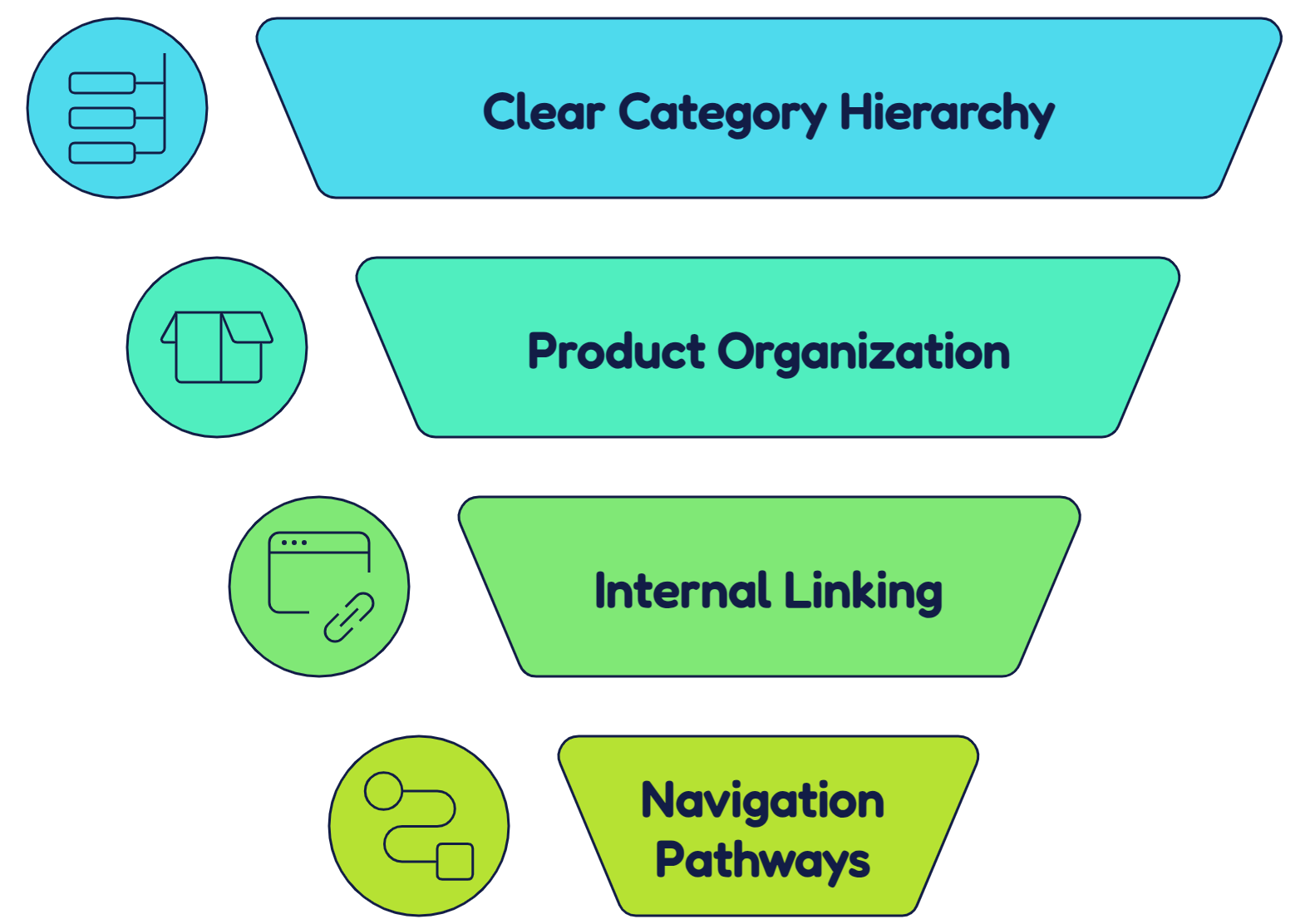
Site structure affects both user experience and crawl efficiency. A flat, logical hierarchy helps search engines understand which pages matter most and helps users navigate without frustration.
The essential elements of strong e-commerce architecture:
-
A clear category hierarchy with logical parent and child relationships
-
Products organised under relevant categories rather than left in isolation
-
Internal links that flow from category pages to product pages and back to supporting content
-
Navigation pathways that let users reach any product within three clicks
Poor site architecture creates orphaned pages, cannibalization between similar product listings, and wasted crawl budget. A well-structured site amplifies every other SEO effort you make.
Optimising Product Pages for AI Search Visibility and Conversions.
Product pages are where organic traffic converts into revenue. They need to work on two levels: satisfying search engine requirements and convincing real buyers to purchase.
Core optimization areas for product pages:
-
Product titles
include primary keywords naturally, describe the product accurately, and match the language buyers actually use when they search -
Product descriptions
go beyond manufacturer copy. Write unique, benefit-led descriptions that answer the questions a buyer has before purchasing. -
Metadata optimization
write title tags and meta descriptions that earn clicks, not just rankings -
Structured data implementation
add a product schema so Google can display price, availability, and review stars directly in search results -
Customer reviews
encourage and display them. Reviews add unique content, build trust, and directly influence purchasing decisions.
Maximising Category Page Performance Through On-Page SEO Services
Category pages often drive more revenue per page than individual product listings because they target broader, higher-volume keywords. Yet most e-commerce stores treat them as simple product grids with no additional content.
Dedicated on-page SEO services focus on category pages by adding targeted introductory copy that targets primary and secondary keywords, strengthening internal links between categories and products, and improving filters, sorting, and navigation so users genuinely benefit. An experienced on-page SEO expert also identifies duplicate content patterns across filtered URLs and resolves them before they suppress rankings.
Strong category pages rank for competitive head terms, funnel buyers efficiently toward products, and support the overall authority of your domain.
Creating Content That Attracts Buyers Throughout the Customer Journey
Not every shopper arrives ready to buy. A content strategy that targets only transactional keywords misses a large portion of potential customers who are still earlier in their decision process.
Effective content types for e-commerce:
-
Buying guides
detailed advice on how to choose between product types, targeting commercial investigation keywords -
Product comparisons
side-by-side breakdowns that help buyers make confident decisions -
Industry insights
authority-building articles that demonstrate expertise in your product category -
Educational content
how-to articles and tutorials that introduce your products to audiences at the awareness stage -
Frequently asked questions
concise answers to common buyer queries, often eligible for featured snippet placement
Each piece of content should connect back to relevant categories or product pages through clear internal links.
Developing Topical Authority Within Your Ecommerce Niche
Search engines increasingly reward websites that demonstrate deep expertise across an entire subject area. Individual keyword optimization alone does not sustain high rankings at scale anymore.
Topical authority means building content clusters around your core product categories. A central pillar page covers a broad topic in depth. Supporting articles cover specific sub-topics in detail and link back to the pillar. Over time, this cluster structure tells search engines that your site is the go-to resource for that subject.
Glossaries, FAQs, and comparison tools reinforce this authority further. Consistent publication that covers every angle of your niche builds the kind of search engine trust that sustains top rankings through algorithm updates.
Technical SEO Essentials for WordPress E-commerce Success
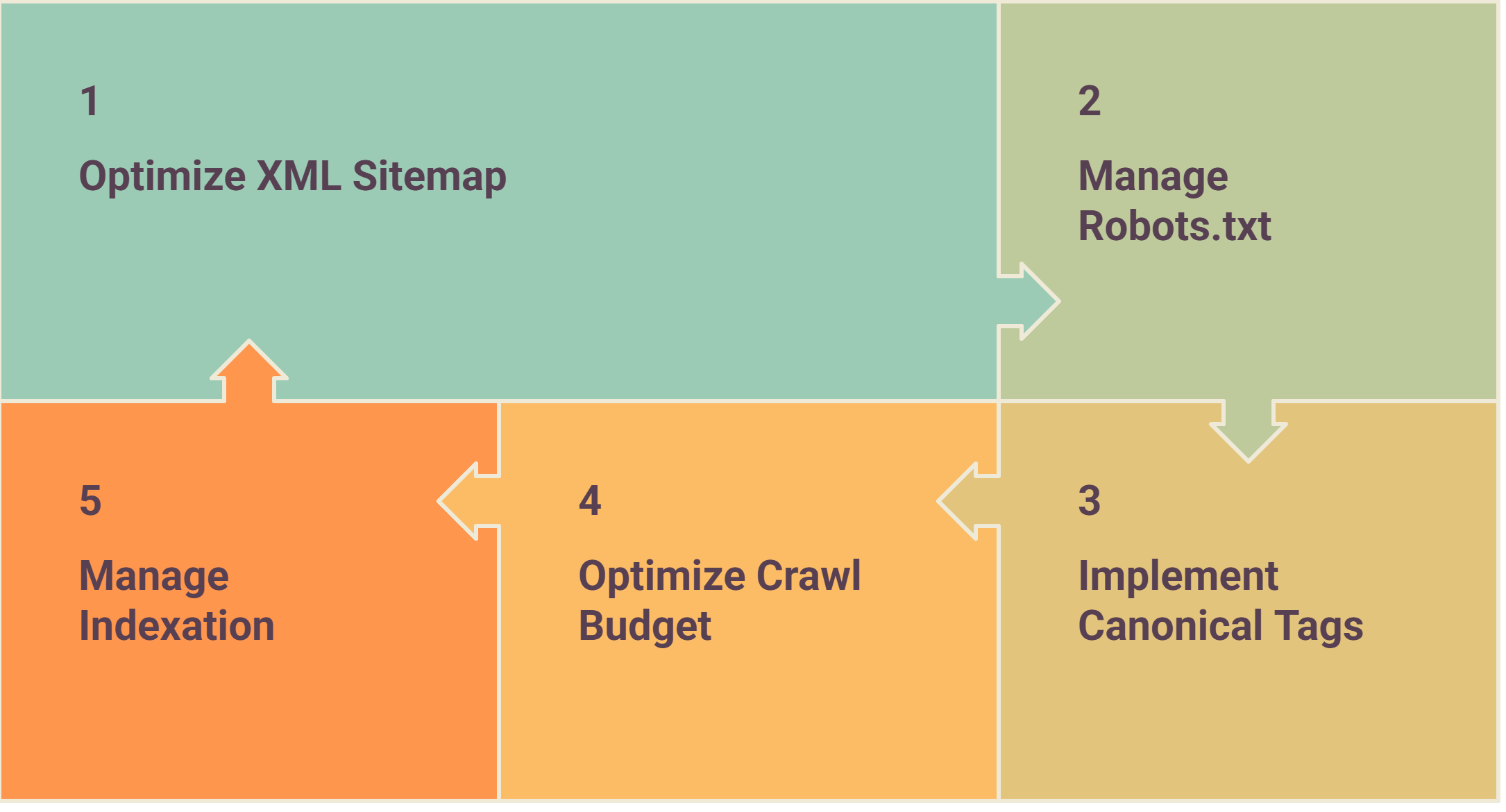
No content or authority strategy delivers its full potential on a technically flawed site. The technical SEO checklist for a WordPress e-commerce store:
- XML sitemap optimization to ensure all key pages appear and no irrelevant pages get submitted
- Robots.txt management to prevent search engines from wasting crawl budget on checkout or admin pages
- Canonical implementation to resolve duplicate content across product variations and filtered category pages
- Crawl budget optimization for large catalogues with hundreds or thousands of product listings
- Indexation management to confirm that your most valuable pages are actually indexed
Why Technical SEO Experts Prioritise Site Performance
Technical SEO experts consistently identify Core Web Vitals as one of the most impactful ranking and conversion factors for e-commerce stores. Google uses Core Web Vitals as a direct ranking signal. Slow pages lose buyers, too. Conversion rates drop as page load time increases, and the data across every major e-commerce sector backs this up.
Key performance focus areas:
- Core Web Vitals: LCP, INP, and CLS scores
- Mobile usability across all product and category pages
- Page speed through caching, code minification, and lazy loading
- Server performance and hosting quality
- Image optimization through compression and next-generation formats like WebP
Leveraging Schema Markup to Improve Search Visibility
Structured data is one of the most underleveraged opportunities in e-commerce SEO. Schema markup communicates additional context to search engines and enables enhanced results that stand out from standard listings.
Important schema types for e-commerce:
| Schema Type | Benefit |
|---|---|
| Product schema | Shows price, availability, and condition in search results |
| Review schema | Displays star ratings directly in SERPs |
| FAQ schema | Expands your listing with common questions and answers |
| Breadcrumb schema | Improves navigation display in search results |
| Organizational schema | Strengthens brand entity recognition |
Preparing Your Ecommerce Store for AI-Powered Search
Search behavior has shifted. AI-generated results now appear at the top of many Google searches, and users interact with search through conversational queries rather than short keyword phrases, far more than they did two years ago.
Preparing your WordPress e-commerce store for this shift means optimizing for entity-based search, where Google understands your brand, products, and expertise as connected entities rather than isolated pages. Write content that directly answers specific questions a buyer might ask conversationally. Ensure your structured data, author information, and About page clearly establish who you are and what you sell.
How AI SEO Service Solutions Support Ecommerce Growth
The best AI SEO agencies combine artificial intelligence tools with human strategy. They do not replace human judgment with automation. That distinction matters enormously. An AI SEO service adds genuine value across several areas:
-
Advanced keyword discovery
AI tools identify search opportunities and semantic relationships that manual research misses -
Content optimization insights
machine learning analysis of top-ranked pages reveals the topics, entities, and structures your content needs. -
Competitive intelligence
rapid analysis of competitor content gaps at scale -
Search trend forecasting
identification of rising search terms before they reach peak competition
A reputable AI SEO company uses these capabilities to inform strategy, not to generate low-quality automated content that damages your site’s credibility with both users and search engines.
The Role of User Experience in Organic Search Performance
Google measures how users behave on your site, and that behaviour influences rankings directly. A technically sound site that frustrates users will see rankings erode over time as engagement signals deteriorate.
UX factors that directly influence organic search performance:
-
Navigation clarity – users find what they need without confusion
-
Mobile experience – product and category pages perform flawlessly on smartphones
-
Page engagement – users scroll, interact, and spend meaningful time on your pages
-
Conversion pathways – clear routes from search landing to product to basket to purchase
Better UX benefits both rankings and revenue at the same time.
Building Authority Through Strategic Off-Page SEO Services
Rankings for competitive e-commerce keywords require genuine domain authority. That authority comes from the quality and relevance of sites that link to yours. It does not come from shortcuts.
Professional off-page SEO services focus on authority-building techniques that produce lasting results:
-
Digital PR – earning coverage and links from publications relevant to your product category
-
Editorial backlinks – links earned through genuinely useful content rather than purchased or exchanged
-
Industry citations – appearances in directories, roundups, and resource lists within your niche
-
Brand mentions – even unlinked mentions; contribute to entity authority in modern search algorithms
-
Content promotion – distributing strong content so it earns natural links over time
How an Off-Page SEO Company Strengthens Brand Trust and Visibility
A specialist off-page SEO company does not simply acquire backlinks in bulk. It builds a coherent authority profile by targeting links from sources genuinely relevant to your industry and audience.
Quality link acquisition focuses on domain authority, topical relevance, and editorial standards. A single link from a respected industry publication outweighs dozens of links from irrelevant directories. Every time.
Reputation management matters here, too. Positive brand signals across the web, press coverage, customer reviews on third-party platforms, and consistent social proof all contribute to the trust signals search engines use to evaluate your site.
Ecommerce SEO Statistics and Market Trends
| Metric | Industry Insight |
|---|---|
| Organic traffic contribution | A major source of e-commerce website visits across all categories |
| Mobile search growth | Continues to increase year over year, now dominant in many niches |
| AI search adoption | Rapidly transforms how buyers discover and compare products |
| Page speed impact | Directly influences both conversion rates and organic rankings |
| User reviews | Strong contributor to purchasing decisions and local search visibility |
Comparing SEO Strategies for Ecommerce Growth
| Strategy | Traffic Potential | Cost Efficiency | Long-Term Value | Conversion Impact |
|---|---|---|---|---|
| Paid advertising | High | Moderate | Low | High |
| Content marketing | High | High | High | Medium |
| Technical SEO | Medium | High | High | High |
| Off-page SEO | High | Medium | High | Medium |
| AI SEO service | High | High | High | High |
Common SEO Mistakes That Limit Ecommerce Growth
Many e-commerce stores stall their own organic progress by repeating the same errors:
-
Duplicate content – product descriptions copied from suppliers or replicated across multiple variant pages
-
Poor product descriptions – thin, generic copy that adds no value beyond the product title
-
Weak internal links – no structure connecting category pages, product pages, and supporting content
-
Ignoring technical SEO – crawl issues, slow pages, and indexation problems left unresolved for months
-
Low-quality backlinks – links from irrelevant or low-authority sources that add no trust to your domain
Each of these mistakes is entirely avoidable with the right strategy in place.
Measuring SEO Performance Beyond Rankings
Rankings matter, but they are a leading indicator, not the final measure of success. The key performance indicators that demonstrate real business impact:
-
Organic revenue – direct sales attributed to search traffic
-
Assisted conversions – how often organic search contributes to purchases completed through another channel
-
Customer lifetime value – whether organic buyers return and spend more over time
-
Average order value – whether organic traffic attracts buyers who purchase higher-value products
-
Return on SEO investment – revenue generated per pound of SEO spend
Building a Scalable WordPress SEO Consulting Strategy
Sustainable growth through WordPress SEO consulting follows a clear sequential logic. Technical optimization lays the foundation. Content expansion builds topical coverage and captures more search demand. Authority building earns the trust signals needed to compete for high-value keywords. Conversion enhancement turns that traffic into measurable revenue.
Each stage compounds the one before it. A site with strong technical foundations ranks new content faster. A site with deep topical authority earns links more naturally. A site with high organic revenue justifies further SEO investment and accelerates the cycle further still.
Why Leading Ecommerce Brands Invest in Professional WordPress SEO Services
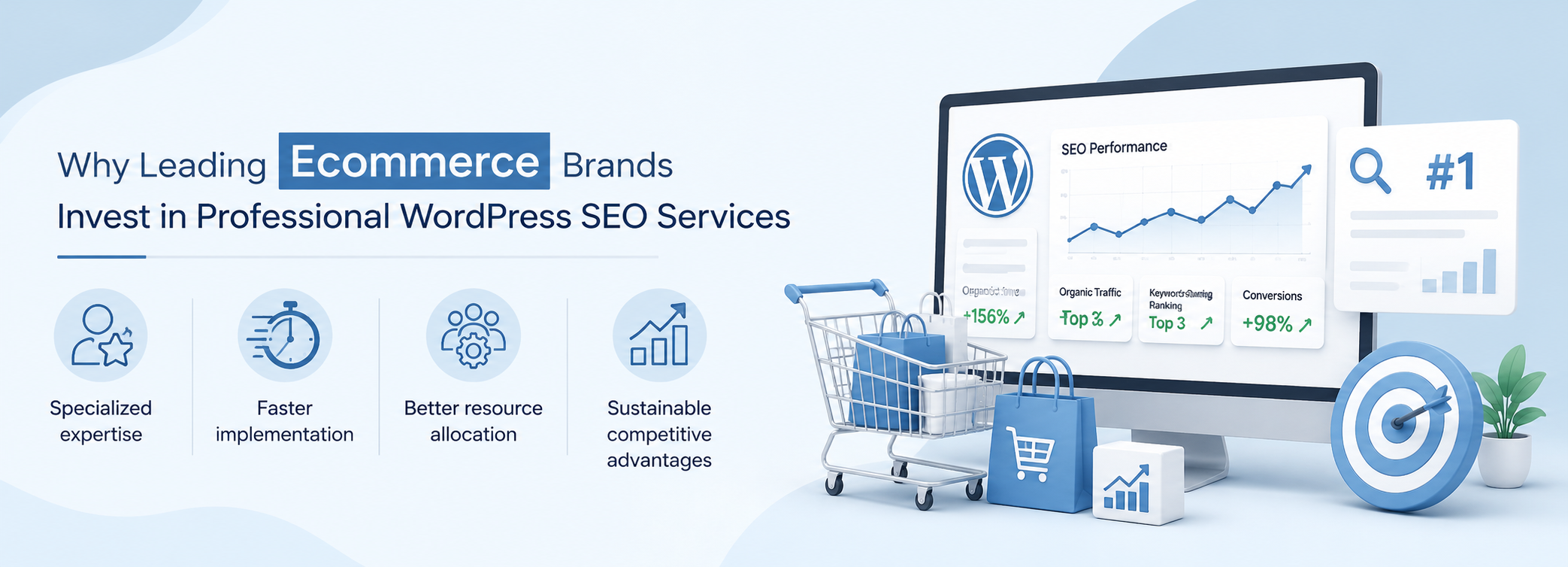
Businesses that hire professional SEO expertise consistently outperform those that treat SEO as an occasional task handled internally by non-specialists. The reasons are straightforward:
-
Specialized expertise
professionals keep pace with algorithm changes, emerging search trends, and technical best practices on a full-time basis -
Faster implementation
experienced teams execute optimizations and content strategies without the trial-and-error learning curve -
Better resource allocation
a focused SEO strategy avoids wasted effort on low-impact activities -
Sustainable competitive advantages
professional SEO builds assets that resist erosion and compound value over the years
Selecting the Right WordPress SEO Company for Your Business
Choosing a WordPress SEO company requires careful evaluation. The right partner should demonstrate:
- Industry experience – proven work with e-commerce clients, not just general website projects
- Proven results – case studies and verifiable data that show traffic and revenue growth
- Technical capabilities – the ability to handle both strategic SEO and hands-on technical implementation
- Reporting transparency – clear, regular reporting that shows exactly what work is done and what results it produces
- Ecommerce specialization deep – familiarity with WooCommerce, product schema, category architecture, and conversion-focused content
Conclusion: Building a Sustainable Organic Growth Strategy for Ecommerce Success
Organic search remains the most cost-effective and defensible growth channel available to WordPress e-commerce businesses. Paid advertising delivers results while the budget runs. SEO builds an asset that grows over time and keeps working long after the initial investment.
The businesses that win in organic search combine a solid technical foundation with a genuine content strategy, a coherent authority-building program, and consistent attention to user experience. None of these elements work in isolation. Together, they create the compounding growth that separates market leaders from businesses permanently dependent on ad spend.
For e-commerce brands that want to reduce paid dependency and build long-term organic visibility, Willshall Consulting has helped hundreds of businesses across industries achieve consistent search growth through professional WordPress SEO services, technical SEO expertise, AI-driven optimization, and full-funnel e-commerce strategy.
Accelerate Your Ecommerce Growth with Expert SEO Support
Partner with Willshall Consulting for professional WordPress SEO services, technical SEO expertise, AI SEO strategies, and comprehensive e-commerce optimization solutions designed to increase rankings, traffic, and revenue.
With a Bachelor’s in Commerce and 15 years of experience in Ecommerce SEO and Shopify Development, I bring extensive expertise to the digital field. As Managing Partner at WillShall Consulting, I lead a team delivering exceptional Digital Marketing, Web Development, and Web Designing services. My passion for innovation and commitment to excellence help businesses thrive in the digital age.
Frequently Asked Questions about WordPress SEO Services

Looking to boost your online presence and reach more customers in your local area?
Explore Local SEO ServiceKnow your website’s SEO Score.
Get a customize SEO Audit report & improve your website statistics.