Most online stores have a traffic problem. Not too little traffic. Too much of the wrong kind. Store owners spend money on ads, watch sessions climb in Google Analytics, and still stare at flat revenue numbers. The visitors arrive. They browse. They leave. No purchase. No email signup. Nothing.
That gap between traffic and revenue is exactly what e-commerce SEO services exist to close. Not just rank pages higher. Not just drive more clicks. Pull in the buyers who already want what the store sells and give them every reason to complete the purchase. This guide by Willshall Consulting breaks down exactly how that works.
A focused e-commerce SEO company does not treat all visitors as equal. It builds strategies around the difference between someone who typed “What are hiking boots?” and someone who typed “buy waterproof hiking boots size 11 men.” One is curious. One has a credit card ready. That distinction drives every decision in a conversion-focused SEO strategy.
The digital commerce space has never been more crowded. Stores that win in 2026 show up first in search results and convert those clicks into actual customers. SEO shapes revenue, reduces acquisition costs, and builds customer retention over time. The right strategy and the right partner make all the difference.
Unlock Higher Revenue with E-commerce SEO Services.
Work with a results-driven e-commerce SEO service to increase visibility, attract buyers, and maximize conversions.
Why E-commerce SEO Services Matter for Conversion Growth
Traffic without conversion is an expensive vanity metric.
A well-built e-commerce SEO service targets users who show purchase intent, not just curiosity. When someone searches for “best noise-canceling headphones under $200,” that person is not doing research for a school project. They want to buy. SEO strategies built around those queries attract visitors who convert at rates that paid ads rarely match.
People trust organic results more than ads. When your store shows up naturally at the top of Google, shoppers see it as a brand worth buying from. No ad label. No skepticism. Just trust. That perception reduces hesitation and speeds up the purchase decision.
The long-term ROI gap between SEO and paid advertising is also significant. Pay-per-click stops the moment the budget runs dry. SEO compounds. Every optimized product page, every earned backlink, and every technical improvement add to a foundation that keeps generating revenue without additional spend. The math favors SEO for any store that plans to exist three years from now.
Common Challenges Faced by E-Commerce SEO Companies
The biggest failure is the absence of a conversion-first strategy. Agencies celebrate a jump from position eight to position three without asking whether that keyword actually attracts buyers. High rankings on the wrong keywords produce traffic reports that look impressive and sales figures that do not move.
Weak product page optimization compounds the problem. Product pages are where money changes hands. Thin descriptions, generic titles, missing schema, and poor keyword alignment all reduce both rankings and conversions at the same time. Fixing these pages is often the fastest path to revenue improvement.
Site speed, mobile behavior, and user experience rarely get enough attention from budget SEO providers. Over 60 percent of e-commerce purchases now happen on mobile devices. A store that loads in four seconds on a smartphone has already lost a significant portion of its potential buyers before they see a single product.
What Makes a High-Performing Ecommerce SEO Company
The difference shows up in the audit.
A high-performing e-commerce SEO company starts every engagement with a data-driven audit that maps gaps in both rankings and revenue performance. It does not produce a generic list of recommendations. It connects every finding to a specific business impact and prioritizes fixes by revenue potential.
Keyword mapping at a high level goes beyond finding popular search terms. Strong agencies build strategies around the full product funnel. Awareness queries at the top. Comparison searches in the middle. Highly specific, purchase-ready terms at the bottom. Every page targets the right buyer at the right stage.
Technical SEO structure holds everything together. A store that grows from 200 to 2,000 products needs an architecture that search engines can crawl efficiently, and users can navigate without friction. Clean URL structures, logical category hierarchies, fast load times, and proper canonical setup create the foundation on which content and link strategies actually work.
On-Page SEO Services for Product Page Optimization
Product pages generate revenue. On-page SEO services make sure those pages earn their place in search results and convert the traffic they attract.
Titles and meta descriptions matter more than most store owners realize. These two elements are the first impression a potential buyer gets before they even visit the site. A strong title earns the click. A compelling meta description reinforces the reason to click through rather than scroll past.
Product content goes deeper than keyword placement. Good product descriptions answer one question: why should I buy this? They use real words that shoppers actually search for, which helps pages rank without forcing anything.
Schema markup makes your listings look better in Google search results. Shoppers can see star ratings, prices, and stock availability before they even click. That alone brings in more qualified traffic.
Internal links connect everything. They move shoppers from a category page to the right product and from one product to something related. Less confusion. Smoother path to purchase.
Off-Page SEO Agency Strategies for Authority Building
What happens off the site shapes how the site ranks.
An off-page SEO agencybuilds the external trust signals that tell search engines a store deserves top positions. Backlinks build authority, but one link from a trusted industry site is worth more than a hundred links from random directories. Quality always beats quantity.
Digital PR creates multiple advantages at once. Earning mentions in industry publications, product review sites, and authoritative blogs builds both search authority and direct consumer trust. A shopper who sees a store featured in a credible publication arrives with a higher level of confidence than one who found the store through a cold ad. Those signals compound over months and create a competitive position that is genuinely difficult for newcomers to replicate.
Shopify SEO Services for High-Converting Stores
Shopify powers a huge share of e-commerce stores, but the platform creates specific SEO challenges that general strategies miss. Shopify SEO services address those platform-specific issues directly.
Duplicate content from product variants is one of the most common Shopify SEO problems. When color or size variations generate separate URLs without proper canonical tags, search engines see thin duplicate pages instead of one strong product page. This splits ranking authority and reduces the overall strength of the product listing.
Site speed degrades over time as stores add apps, features, and integrations. Each app adds scripts. Scripts slow the page. Slow pages lose shoppers. Too many apps slow your store down. Good Shopify SEO work removes what is not needed and cleans up images, scripts, and theme code, so pages load faster.
A mobile-friendly theme is not enough. Button sizes, navigation, checkout flow, and image display all decide whether a mobile shopper buys or leaves. Stores that optimize specifically for mobile behavior consistently outperform those that treat mobile as an afterthought.
When to Hire a Shopify Expert for Better SEO Results
General SEO knowledge has limits. When a store hits those limits, it makes sense tohire Shopify expert support.
Technical fixes at the Shopify level require platform-specific knowledge. These are not basic fixes. Someone who does not know Shopify well will likely break more things while trying to repair them.
Strategic optimization at scale is another area where a specialist pays for themselves quickly. A Shopify expert knows which apps harm SEO performance, how to structure product hierarchies for crawl efficiency, and how to build content strategies that target buyer-intent queries at every stage of the funnel.
The cost of mistakes on Shopify is real. Duplicate content issues, poor canonical setup, and unoptimized image files can suppress rankings for months without obvious symptoms. By the time the damage shows up in search data, significant revenue has already been lost. Prevention through expertise is cheaper than recovery.
Evaluating the Best E-Commerce SEO Companies
Reviews and case studies tell part of the story. Performance indicators tell the rest.
E-commerce SEO Performance Comparison
Feature
Basic SEO Provider
Growth SEO Agency
Top E-commerce SEO Companies
Strategy Focus
Rankings only
Traffic + some CRO
Revenue + conversions
CRO Integration
Low
Medium
Advanced
Shopify SEO Expertise
Basic
Strong
Expert-level
Reporting Quality
Standard
Advanced
Data-driven insights
ROI Impact
Unpredictable
Stable growth
High and scalable
Use this comparison to benchmark any agency you are considering against what top e-commerce SEO companiesactually deliver.
The best SEO companies for e-commerce connect every SEO activity directly to revenue outcomes. They do not present monthly reports full of keyword rankings without showing what those rankings produced in actual sales. Revenue is the metric that matters. Everything else is context.
ROI tracking methods reveal how seriously an agency approaches accountability. Good agencies show you exactly where your traffic comes from and where it converts using real data from tools like Google Analytics 4, heatmaps, and session recordings. No confusing reports. Just clear numbers you can act on.
Watch out for ane-commerce SEO firm that promises guaranteed rankings, gives vague answers about what they actually do, has no real case studies, or sends you the same proposal they send everyone else. A credible agency asks detailed questions before proposing anything because a real strategy depends on understanding the specific store, market, and competition.
Technical SEO Essentials for E-commerce Growth
Technical SEO is not glamorous. It is also non-negotiable.
Crawlability and indexing determine whether search engines can find and rank the store’s pages at all. Large e-commerce stores accumulate crawl waste through outdated product pages, broken links, orphaned category pages, and bloated XML sitemaps. Regular audits spot and fix these problems before they quietly hurt your entire site’s rankings.
A well-organized site works better for everyone. Google understands it faster, and shoppers find what they want without clicking around in frustration. Good architecture serves both goals at the same time.
Schema markup and structured data give product pages a direct advantage in search results. Product schema enables star ratings, price information, and stock status to appear in the search listing itself. Those enhanced listings attract more clicks from qualified buyers and reduce the number of irrelevant visitors who bounce immediately after arrival.
Keyword Strategy in E-commerce SEO Service Execution
Keyword strategy is where most stores either win or waste their budget.
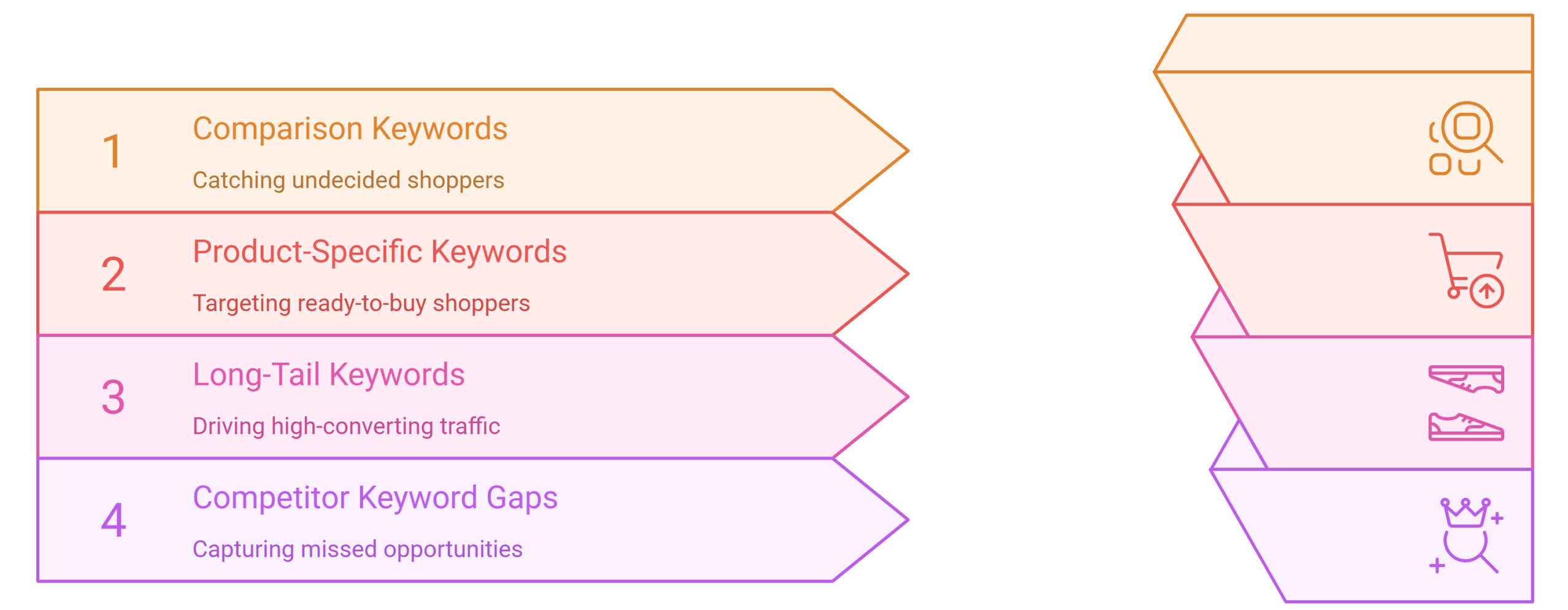
Buyer-intent keyword mapping covers the full funnel. Broad informational queries build early awareness. Comparison keywords catch shoppers who are still deciding. Product-specific keywords catch shoppers who are ready to buy. Covering all three stages keeps your store visible at every point in the buying journey.
Long-tail keywords do not get enough credit. Someone searching “waterproof trail running shoes women size 8 wide” is not browsing. They are buying. These specific searches bring smaller traffic but convert at much higher rates than broad terms.
Competitor keyword gap analysis shows you what your competitors rank for that you do not. These are real buyers already searching for products like yours. Targeting these gaps with optimized pages is one of the fastest ways to drive measurable revenue growth.
Conversion Rate Optimization (CRO) + SEO Integration
SEO brings the visitor. CRO converts them. Neither works as well without the other.
Every organic click should land on a page built to sell. A product page that ranks well but fails to build trust or make buying easy will waste every visitor it attracts.
UX improvements remove the small obstacles that stop people from buying. Fast load times, clear buttons, visible reviews, and simple navigation all make the path to purchase shorter. Less friction means more sales from the same traffic.
Stop guessing what works on your product pages. A/B testing gives you real answers. Test headlines, images, buttons, and layouts, and let the data tell you what actually makes people buy.
E-commerce SEO Service Models Comparison
SEO Service Models
Feature
Freelancer SEO
In-House SEO Team
E-commerce SEO Agency
Cost Efficiency
High (low cost)
Low (high salary cost)
Balanced ROI-based pricing
Expertise Level
Limited
Moderate
High (multi-specialist team)
Scalability
Low
Medium
High and scalable
Strategy Depth
Basic execution
Brand-focused strategy
Full SEO + CRO strategy
Tools and Technology
Limited
Internal tools
Advanced SEO platforms
Shopify SEO Expertise
Basic
Varies
Strong (Shopify SEO Agency level)
ROI Consistency
Unstable
Moderate
High and predictable
This table helps you quickly compare service models and choose the right level of SEO support based on your store’s size, budget, and growth goals
Real Results from Shopify SEO Expert Implementation
A Shopify SEO expert delivers results that show up in analytics, not just ranking reports.
Stores that run structured SEO and CRO strategies together report meaningful organic traffic growth within the first three to six months. More importantly, that traffic converts at higher rates because the strategy targets buyer-intent queries from the start rather than chasing volume for its own sake.
Revenue growth from optimized product pages builds over time. A page that ranks well, loads fast, displays cleanly on mobile, and answers specific buyer questions keeps generating revenue every month without additional ad spend. The initial investment pays back repeatedly.
The combination of technical SEO, content strategy, and conversion optimization creates a growth engine that scales with the store. More products, more categories, and larger catalogs all benefit from the same foundation without requiring proportional increases in budget.
Technical Stats and Industry Trends in E-commerce SEO Services
The data points in one direction:
Over 53% of e-commerce traffic comes from organic search
SEO-driven users convert 2.5 times higher than paid-traffic visitors
Mobile-first indexing now influences over 60% of all online purchases
AI-powered SEO tools continue to increase efficiency and precision across e-commerce SEO services
Organic search is not a supplementary channel. It is the primary driver of sustainable e-commerce growth. Brands that build strong SEO foundations now create a compounding advantage that competitors reliant on paid advertising simply cannot match over the long term.
Common Mistakes in E-commerce SEO Services
Even experienced teams make these errors:
Skipping product page optimization: Product pages drive revenue. Thin content, missing keywords, and weak page structure hurt your rankings and your sales at the same time. Fix one, and you fix both.
Poor internal linking structure: Shoppers cannot find their way to purchase, and search engines do not crawl those pages properly either.
Overlooked technical SEO errors: Slow pages, broken redirects, duplicate content, and crawl issues quietly drag rankings down for months before anyone notices something is wrong.
Regular audits catch all of this early before small problems turn into big ranking drops.
Expert Tips for Maximizing Ecommerce SEO ROI
Start with buyer-intent keywords. A smaller group of people searching with purchase intent will always outperform a large crowd that is just browsing with no plan to buy.
Combine SEO with CRO from day one. Getting to page one means nothing if the page does not convince anyone to buy. Both have to work together.
Keep updating your product pages. What worked six months ago may not be working now. Let the data tell you what needs to change and act on it regularly.
Expert insights from
Sahil Harish SEO Executive
“The future of e-commerce SEO is not visibility. It is conversion intelligence.”
Three things are changing how e-commerce SEO works right now.
AI tools now handle tasks that used to take days. Keyword research, content planning, and performance tracking all move faster. Stores that use these tools get ahead while others are still doing everything manually.
Voice search is growing. More shoppers talk to Siri or Alexa instead of typing. If your store is not optimized for how people actually speak, you are missing a chunk of buyers who are ready to purchase.
Personalization now affects rankings. Search engines have gotten smarter at matching content to what a specific buyer wants. Stores that speak to a specific customer win. Stores that try to appeal to everyone usually connect with no one.
Why Choose WillShall Consulting for E-commerce SEO Services
Willshall Consulting does not separate SEO from conversion work. Both run together in every campaign because ranking without selling is pointless.
Every strategy they build starts with one question: what will actually grow revenue for this store? Not what looks good in a report. Not vanity metrics. Real business results.
Whether a store needs a full SEO rebuild or targeted Shopify fixes, the team builds around where the store is right now and where it needs to go.
Conclusion: Scaling with E-commerce SEO Services
Chasing ads and algorithm updates is not a growth strategy. Real growth comes from building something that attracts the right buyers, removes friction at checkout, and keeps working as the business scales.
E-commerce SEO services do exactly that when conversion sits at the center of the strategy, not just rankings. Technical precision, buyer-intent keyword targeting, product page optimization, and CRO form a unified system that generates revenue month after month.
The choice of an e-commerce SEO company determines whether that system gets built correctly. An agency focused on rankings delivers rankings. An agency focused on revenue delivers growth. The distinction matters enormously to the bottom line.
Willshall Consultinghas built its reputation on that second outcome. Measurable, scalable, conversion-driven ecommerce growth that clients can see in their revenue data.
Start scaling with e-commerce SEO services today
Contact WillShall Consulting for high-performance Shopify SEO strategies that drive traffic, leads, and consistent sales growth.
With a Bachelor’s in Commerce and 15 years of experience in Ecommerce SEO and Shopify Development, I bring extensive expertise to the digital field. As Managing Partner at WillShall Consulting, I lead a team delivering exceptional Digital Marketing, Web Development, and Web Designing services. My passion for innovation and commitment to excellence help businesses thrive in the digital age.
Frequently Asked Questions About E-commerce SEO Services
They are strategies that help your online store rank higher on Google and get more sales from that traffic.
They target the right keywords, fix site problems, and optimize product pages so more visitors turn into buyers.
Shopify is not like other platforms. Someone who knows it inside out will save you from months of hidden SEO damage.
Everything from speed fixes and keyword research to product page rewrites and technical cleanup that most people never even look at.
They fix your page titles, content, and images so your store ranks better and shoppers find it easier to buy.
They stop obsessing over rankings and start caring about what actually matters, which is your revenue at the end of the month.
Most stores start seeing real movement around month three or four. Give it a full year, and the results compound significantly.
Ads need constant money to keep running. SEO builds on itself over time and keeps working even when you are not spending.
With a Bachelor's in Commerce and 15 years of experience in Ecommerce SEO and Shopify Development, I bring extensive expertise to the digital field. As Managing Partner at WillShall Consulting, I lead a team delivering exceptional Digital Marketing, Web Development, and Web Designing services. My passion for innovation and commitment to excellence help businesses thrive in the digital age.





 Upwork
 Fiverr
 People Per
Hour
People Per
Hour
 By Sachin Sharma
|
22-May-2026
By Sachin Sharma
|
22-May-2026